40 Breakup Journal Prompts for When You’re Still Not Over It
So, the breakup happened.
Maybe it ended in one spectacular argument. Maybe it was mutual, which somehow hasn’t made it hurt any less. Maybe they disappeared without giving you a real ending. Or maybe you were the one who ended it and now you’re wondering whether you made a terrible mistake.
Either way, your brain has become an unpaid detective.
It is rereading old conversations, examining the final weeks for clues and producing increasingly unhelpful theories at 2 a.m.
You don’t need to write a beautiful reflection about everything the relationship taught you.
You need somewhere to put the thoughts before you text them.
These breakup journal prompts are for the missing-them days, the angry days, the maybe it wasn’t that bad days and the strange Tuesday three months later when a song brings the whole thing back.
Start with the section that matches what is happening in your head right now. You do not need to work through every prompt or answer them in order.
This is not homework. It’s somewhere to put the breakup.
Before You Start: Don’t Turn This Into Another Spiral
Journaling after a breakup can help you name what happened, separate facts from assumptions and say the things you should probably not send directly to your ex.
But more writing is not always better.
Research on expressive writing after separation is more complicated than the internet often makes it sound. One study found that repeatedly writing emotionally about a separation could actually make recovery harder for people who were already highly preoccupied with the breakup. A later study found better physical outcomes when separated adults wrote their experience as a coherent story with a beginning, middle and end.
In other words: writing can be useful, but endlessly documenting the same pain is not automatically healing.
Use these prompts to notice, clarify and unload not to conduct a six-hour investigation into why they watched your Instagram Story but didn’t reply.
If you feel more distressed as you write, close the journal. Get some water, change rooms, message someone safe or return to something happening in your actual life.
You can come back later. The prompt will survive.
If you want help setting up the journal itself, start with How to Start a Breakup Journal Without Spiralling. That guide covers how to begin, what to keep in it and how to stop the journal from becoming a shrine to the relationship.
Breakup Journal Prompts for When You Can’t Stop Thinking About Them
This is for the stage where everything somehow leads back to them.
A song. A café. Someone wearing the same shoes. A completely unrelated TikTok that your brain has decided is a sign.
Don’t argue with the thoughts. Put them somewhere specific.
- What thought about them keeps repeating today?
- What am I hoping will happen if I keep thinking about this?
- What do I want from them right now: contact, comfort, an apology, reassurance or another chance?
- What am I trying to understand that I may never get a clear answer to?
- Which parts of the relationship am I replaying most—and which parts am I leaving out?
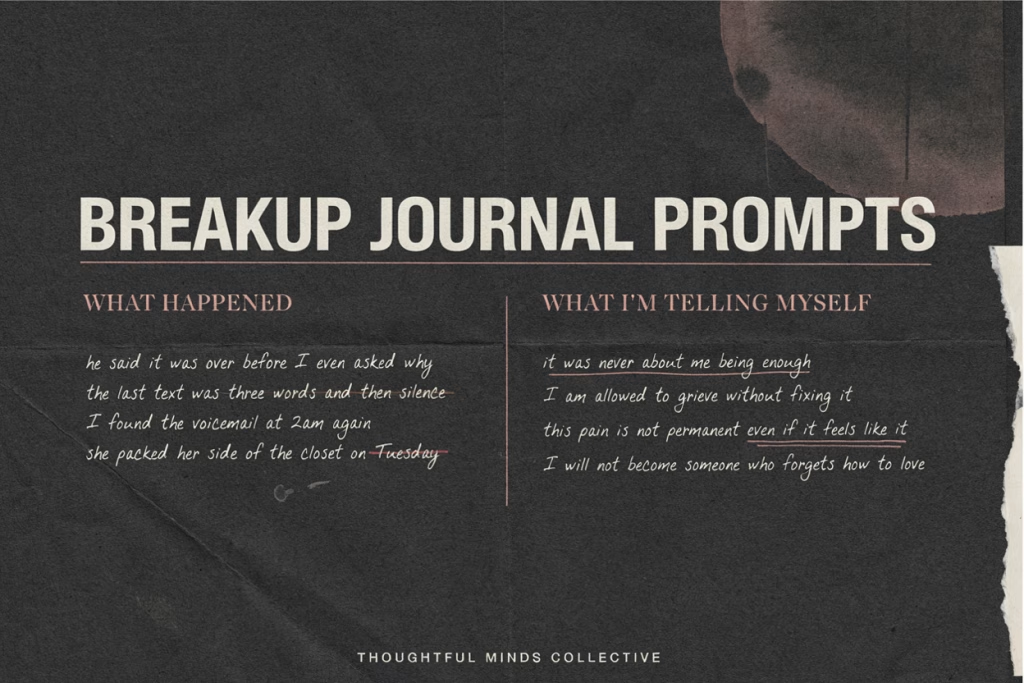
- What happened, based only on the facts I know?
- What story have I built around those facts?
- If I knew they would never contact me again, what would I need to face?
That sixth and seventh prompt can be particularly useful together.
For example:
Fact: They haven’t replied in nine days.
Story: They are waiting for me to prove that I care.
The story might be true. It might not. The important thing is recognising which part you actually know.
Breakup Journal Prompts for When You Miss Them
Missing someone is not proof that the relationship should restart.
It means you formed an attachment. You had routines, private jokes, familiar conversations and a person woven into the ordinary parts of your life.
You can miss all of that and still know the relationship wasn’t working.
- What do I miss about them specifically?
- What do I miss about being in a relationship?
- What routine or ritual disappeared when the relationship ended?
- What did being with them allow me to feel about myself?
- Am I missing who they actually were—or who I kept hoping they would become?
- What does nostalgia keep editing out?
- What was I regularly disappointed by in the relationship?
- What would come back with them besides the parts I miss?
That last question matters.
If they came back, it wouldn’t only restore the Sunday mornings and the way they made you laugh. It would also restore the uncertainty, arguments, mismatched needs or whatever else made the relationship impossible to continue.
Try to remember the whole relationship, not just its highlight reel.
Breakup Journal Prompts for When You Want to Text Them
Open the journal before you open the chat.
You are allowed to want contact. You just don’t have to act on every version of that feeling.
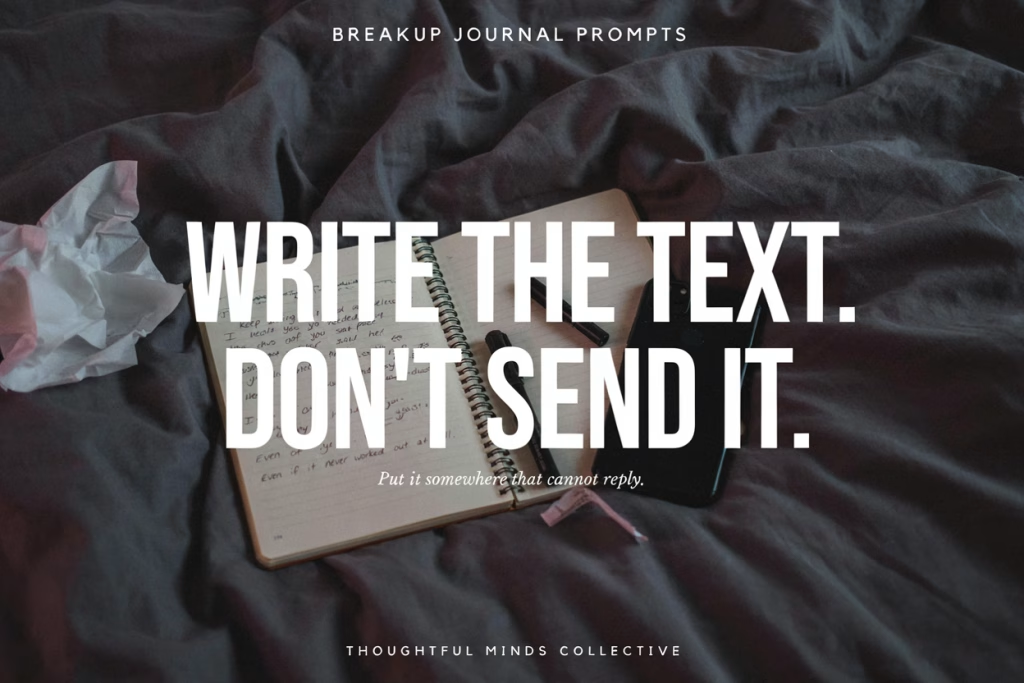
- What do I want to text them right now?
Write it exactly as you would send it. Don’t make it dignified.
- What response am I hoping to receive?
- How would I feel if they ignored the message?
- How would I feel if they replied warmly but still didn’t want the relationship back?
- What happened the last time I contacted them?
- Do I want connection—or relief from what I’m feeling right now?
- What could I do for the next twenty minutes instead of sending this?
- What would tomorrow’s version of me want me to do tonight?
You can write the unsent text and then leave it alone.
No ceremonial burning required. No dramatic declaration that you are releasing them forever. Just don’t press send while the feeling is making the decision for you.
Breakup Journal Prompts for Anger and Betrayal
Sometimes the sadness gets all the attention, but breakups can also leave you furious.
At them. At yourself. At the friend who apparently “always had a bad feeling.” At the amount of time you spent trying to make something work.
Your journal can hold the version that isn’t calm, fair or ready to forgive.
- What am I most angry about?
- What did I tolerate because I wanted the relationship to work?
- What was I pretending not to notice?
- What did I repeatedly explain that they repeatedly chose not to understand?
- Which boundary was crossed and what did I do afterwards?
- What apology do I wish I would receive?
- What would that apology change, and what would it not change?
- What am I blaming myself for that belongs partly or entirely to them?
Write honestly, but don’t use the journal to turn assumptions into evidence.
There is a difference between:
They never cared about me.
and:
When they did this, I felt as though my feelings didn’t matter.
The second statement stays with what you experienced. It gives you something real to work with instead of trying to prove what was happening inside somebody else’s head.
Breakup Journal Prompts for When You’re Blaming Yourself
After a breakup, the brain loves a rewrite.
If only I had been less emotional. More confident. Easier. Less needy. More available. Less available. Somehow exactly the person who could have prevented another person from making their own choices.
Reflection is useful. Taking responsibility for the entire relationship is not.
- What do I genuinely wish I had handled differently?
- What did I communicate clearly?
- What did I need that I was afraid to ask for?
- What responsibility belongs to me—and what does not?
- Was I asking for too much, or asking the wrong person?
- When did I abandon my own needs to keep the relationship steady?
- What did I believe I had to earn from them?
- What would I say to a friend who was blaming themselves for this exact situation?
You don’t need to decide you did nothing wrong. Most of us can find things we would handle differently now.
The goal is accuracy not acquitting yourself of everything and not sentencing yourself for everything either.
More Prompts for the Future You Thought You Were Getting
Breakups don’t only remove a person. They can remove an entire imagined future.
The trip you discussed. The home you pictured. The people you thought would remain part of your life. The version of yourself you expected to become beside them.
That loss counts too.
- What future did I imagine with them?
- Which part of that future am I grieving most?
- What did that imagined life represent to me?
- Which parts of it are still possible without them?
- What now feels uncertain?
- What am I relieved I no longer have to carry?
- What dream was mine before it became “ours”?
- What do I want to reclaim?
You don’t have to replace the old future immediately.
Sometimes the honest answer is simply:
I don’t know what comes next, and I hate that.
Write that.
Prompts for Understanding the Relationship More Clearly
This section is better saved for when you have a little distance. Not necessarily complete objectivity just enough space to see more than the final argument.
- When did I feel most secure in the relationship?
- When did I feel most uncertain?
- What did I keep asking for?
- What did they keep asking for?
- Which conflict did we have in different forms?
- What did I minimise because admitting it would require a decision?
- When did I feel most like myself?
- When did I make myself smaller?
- What worked between us?
- What could love alone not fix?
- Which of my needs were met?
- Which needs remained consistently unmet?
- What relationship pattern do I not want to repeat?
If this breakup is making you notice a familiar pattern similar people, similar uncertainty, similar ending read Why You Keep Falling for the Same People next. It can help you examine the pattern without reducing your entire dating history to one attachment-style label.
Prompts for Closure When You Never Got It
Sometimes the ending is vague, sudden or full of missing information.
You may feel as if you cannot move forward until they finally explain themselves properly.
Unfortunately, some people are deeply committed to being unclear.
These prompts won’t manufacture the answer they withheld, but they can help you stop waiting for them to complete every unfinished sentence.
- What answer am I still waiting for?
- What do I believe that answer would give me?
- What have their actions already told me?
- If their explanation disappointed me, what would I do next?
- What do I know about how the relationship made me feel?
- What did I need them to acknowledge?
- Can I acknowledge that for myself?
- What would accepting “I may never fully understand” look like?
- What can I decide without their agreement?
- What does closure mean if it doesn’t include another conversation?
Closure does not have to mean you’re happy with what happened.
Sometimes it means you stop making your ability to continue dependent on another person finally saying the perfect thing.
Breakup Journal Prompts for Rebuilding Yourself
No, this is not the revenge-body, dramatic haircut, “best version of me” section.
You are not required to emerge from heartbreak hotter, richer and completely unbothered.
Rebuilding can be much less cinematic.
It might mean remembering what you like to eat when nobody else is choosing. Returning to a friend you lost touch with. Getting through an evening without checking their account.
Try:
- What part of myself became quieter in this relationship?
- What did I stop doing?
- Who do I want to reconnect with?
- What feels like mine again?
- What can I choose entirely for myself this week?
- Which spaces or routines need to become my own?
- What did I learn about what I need in a relationship?
- What will I take seriously earlier next time?
- What kind of love feels steady rather than confusing?
- What would feeling like like myself again look like—not looking healed, but actually feeling present in my life?
You don’t have to “find yourself” in one journal session.
Start with what you want for dinner.
A Five-Minute Breakup Journal Page
If the full prompt list feels like too much, use this:
Right now, I feel:
The thought I keep returning to is:
What I wish I could say is:
What I know for certain is:
What I need for the rest of today is:
Stop there.
You do not need to end with gratitude. You do not need to write that everything happens for a reason.
You only need to be honest about this moment.
What to Do With the Unsent Letters
Unsent letters can be useful when you’re carrying a conversation that has nowhere to go.
You might write:
- the apology you deserved
- the explanation you never received
- everything you wish you had said
- everything you are angry they made you feel
- a goodbye you aren’t ready to say aloud
- a letter from your future self to the person you are now
But decide before you start: this is a journal entry, not a draft message.
If writing it makes you want to contact them immediately, leave it overnight. Read it the next day and ask whether sending it would serve your longer-term needs or briefly relieve the discomfort of not being heard.
Those are not always the same thing.
When to Close the Journal
Put the pen down if:
- you are repeating the same conclusion without learning anything new
- you are becoming more agitated with every paragraph
- you are trying to reconstruct their motives from tiny details
- you are using the journal to plan ways to get a reaction
- writing has turned into checking their social media between sentences
- you feel pressured to keep going until you reach a positive ending
A journal is not automatically helpful just because it contains feelings.
Sometimes the better next step is eating, sleeping, showering, leaving the house, talking to someone or doing something with your hands that has absolutely nothing to do with personal growth.
Journaling can be one place to process a breakup. It is not a replacement for professional support, trusted people or practical help especially if the relationship involved abuse, coercion or concerns about your safety.
Need Support?
In Australia, you can contact 1800RESPECT 24/7 by calling 1800 737 732, texting 0458 737 732, or using online chat. If you are in immediate danger, call 000.
United States: Contact the National Domestic Violence Hotline by calling 1-800-799-7233, texting START to 88788, or using online chat. In an emergency, call 911.
United Kingdom: Women can contact Refuge’s National Domestic Abuse Helpline free and confidentially, 24/7, on 0808 2000 247. In an emergency, call 999.
Elsewhere: Use the NO MORE Global Directory to find domestic and sexual violence support services in more than 200 countries and territories.
For additional crisis and mental health services, visit this page.
You Don’t Have to Be Over It Yet
You can understand why the relationship ended and still miss them.
You can know you shouldn’t contact them and still desperately want to.
You can have a good week and then cry because you found their sock behind the dryer.
None of that means you have gone backwards.
Use these breakup journal prompts when they help you put language around the mess. Skip them when they make you live inside it for longer.
The goal isn’t to produce the perfect healing journal.
It’s to give the feeling somewhere to go so, eventually, you can return to the rest of your life.