Can Journaling Help Your Mental Health? What It Can and Can’t Do
Some days, your thoughts arrive one at a time. Other days, they all turn up at once, start talking over each other and refuse to leave.
Journaling can give that mental noise somewhere to go.
It won’t fix every problem, replace therapy or make difficult feelings disappear. But it can help you slow down long enough to notice what you’re thinking, name what you’re feeling and work out what might help next.
And sometimes, that small amount of space between feeling something and being completely consumed by it matters.
Does Journaling Actually Help Your Mental Health?
The honest answer is: it can.
Research into expressive writing suggests that journaling may offer modest mental health benefits, although the results vary between people and different types of writing. A 2022 systematic review found that journaling interventions produced an average reduction in mental health symptoms, with some approaches appearing more useful than others.
That doesn’t mean every journal entry will leave you feeling peaceful. In fact, writing honestly about something difficult can temporarily make you feel worse.
Journaling can still be useful because it helps you:
- put vague feelings into words
- recognise recurring thoughts and patterns
- separate facts from fears
- process an experience at your own pace
- prepare for a difficult conversation
- remember what helped during a previous hard period
- notice when you might need more support
Think of it as one tool in your mental health toolkit not the entire toolkit.
1. Journaling Helps You Name What You’re Feeling
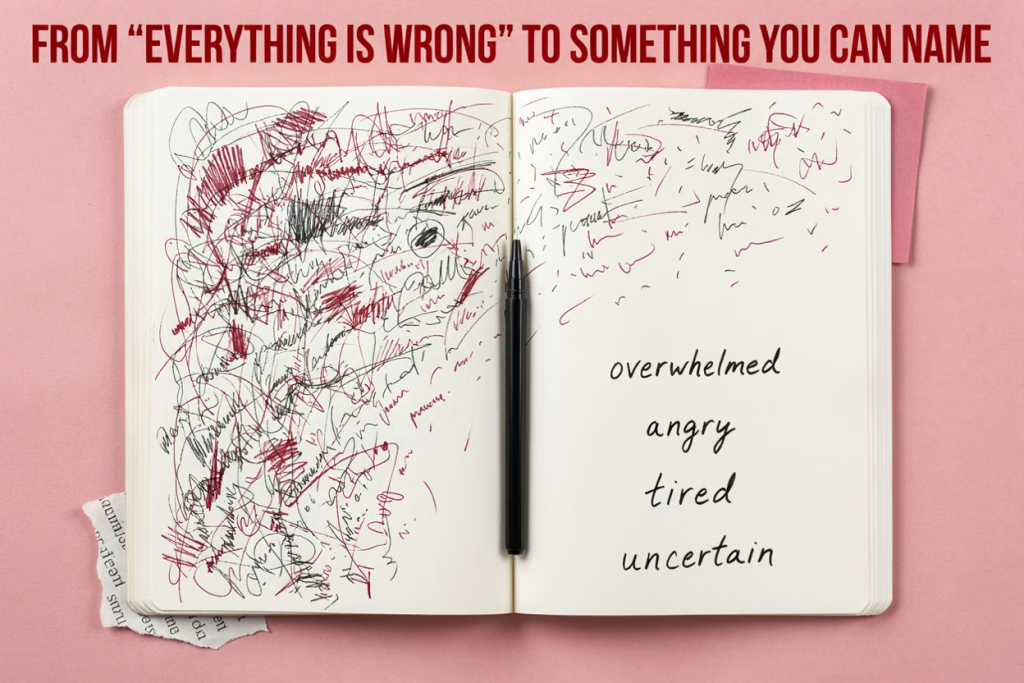
Sometimes you know you feel bad, but that is as specific as you can get.
Are you angry? Disappointed? Lonely? Overstimulated? Worried? Resentful? Exhausted? A strange combination of all six?
Writing can help you move from:
Everything is wrong.
To:
I’m overwhelmed because I’ve agreed to too many things, and I’m worried people will be upset if I say no.
The situation may not have changed, but now you have something you can understand and respond to.
Try beginning with:
- Right now, I feel…
- The part I haven’t said aloud is…
- I think this is bothering me because…
- Underneath the anger, there might be…
- If I’m completely honest with myself…
You don’t need to find the perfect word. Getting a little closer is enough.
2. It Gives Your Thoughts Somewhere to Go
When the same thoughts keep circling, your brain can start to feel like a browser with 37 tabs open and at least one of them is playing music, but you can’t find it.
Writing the thoughts down won’t necessarily solve them. It can, however, take some pressure off your working memory. Instead of repeatedly trying to hold everything in your head, you can place it somewhere visible.
A simple brain dump can include:
- what you’re worried about
- tasks you’re trying not to forget
- conversations you keep replaying
- decisions you need to make
- things you can control
- things you cannot control today
Don’t worry about organising it while you write. Get it out first. Sort it later—if sorting it would actually help.
If you like this less-structured approach, try stream-of-consciousness journaling.
3. Journaling Can Help You Spot Patterns
One difficult day can feel random. Six journal entries about the same problem are harder to dismiss.
Over time, your journal may show you:
- which situations repeatedly drain you
- what tends to happen before your mood drops
- which people leave you feeling calm or unsettled
- when you’re saying yes but meaning no
- which coping strategies genuinely help
- which problems keep returning without changing
This is one of the most useful parts of journaling for mental health. Your journal becomes a record not necessarily of everything that happened, but of what repeatedly affected you.
You might realise:
I’m not inexplicably anxious every Sunday. I’m anxious because I spend Sunday night trying to plan an impossible week.
Or:
I keep writing that I’m tired, but I also keep treating rest like something I have to earn.
That kind of recognition doesn’t instantly solve the pattern. It gives you the chance to interrupt it.
4. Writing Can Create Distance From Anxious Thoughts
An anxious thought can feel like a fact when it is racing through your head.
Writing it down lets you look at the thought rather than only experiencing it from inside.
For example:
I’m going to get this wrong, everyone will notice, and it will be a disaster.
Once it is on paper, you can gently question it:
- What do I know for certain?
- What am I predicting?
- Is there another possible outcome?
- What would I say to a friend having this thought?
- What could I do if the thing I fear actually happened?
This isn’t about forcing yourself to “think positive.” It is about making room for a more complete version of the situation.
Sometimes the balanced thought is not:
Everything will be fine.
It might be:
I don’t know how this will go, but I can prepare, ask for help and deal with the next part when it happens.
That is less sparkly but often much more believable.
5. Your Journal Can Hold the Things You’re Not Ready to Say
There are thoughts that need somewhere to exist before you are ready to share them.
A journal gives you a private place to admit:
- I’m not coping as well as I look.
- I’m angry with someone I love.
- I don’t know what I want.
- Something about this situation feels wrong.
- I need help, but I don’t know how to ask.
You don’t have to make the entry wise, fair or presentable. A private journal can hold the unfinished version.
But privacy and support are not the same thing. If what you’re carrying is affecting your safety, daily life, sleep, relationships or ability to function, writing about it does not mean you have to handle it alone.
Your journal can also help you prepare the first sentence:
I’ve been struggling lately, and I think I need to talk to someone.
6. Journaling Can Make Problems Feel More Specific
A problem such as “my whole life is a mess” is too large to act on.
Writing can help you break it into smaller pieces:
- What is happening?
- What part is most urgent?
- What is outside my control?
- What can I influence?
- What would make today 5% easier?
- Do I need a solution, support, information or rest?
- What is the smallest next step?
Mental clarity does not always arrive as a dramatic breakthrough. Sometimes it looks like sending one email, cancelling one commitment or deciding that tonight is not the night to solve everything.
Five Gentle Ways to Journal for Mental Health
There is no single “correct” method. Match the style of journaling to what you need that day.
1. The Five-Minute Brain Dump
Set a timer for five minutes and write everything currently occupying your mind.
Don’t edit, explain or make it sound reasonable. Stop when the timer ends, then ask:
Is there one thing here that needs my attention today?
The answer can also be no.
2. Name, Need, Next
Write three short lines:
- I feel: What emotion or sensation is present?
- I need: Comfort, information, space, reassurance, food, sleep, support?
- Next: What is one realistic action?
For example:
- I feel: overstimulated and irritable.
- I need: quiet and fewer decisions.
- Next: put my phone away and make something easy for dinner.
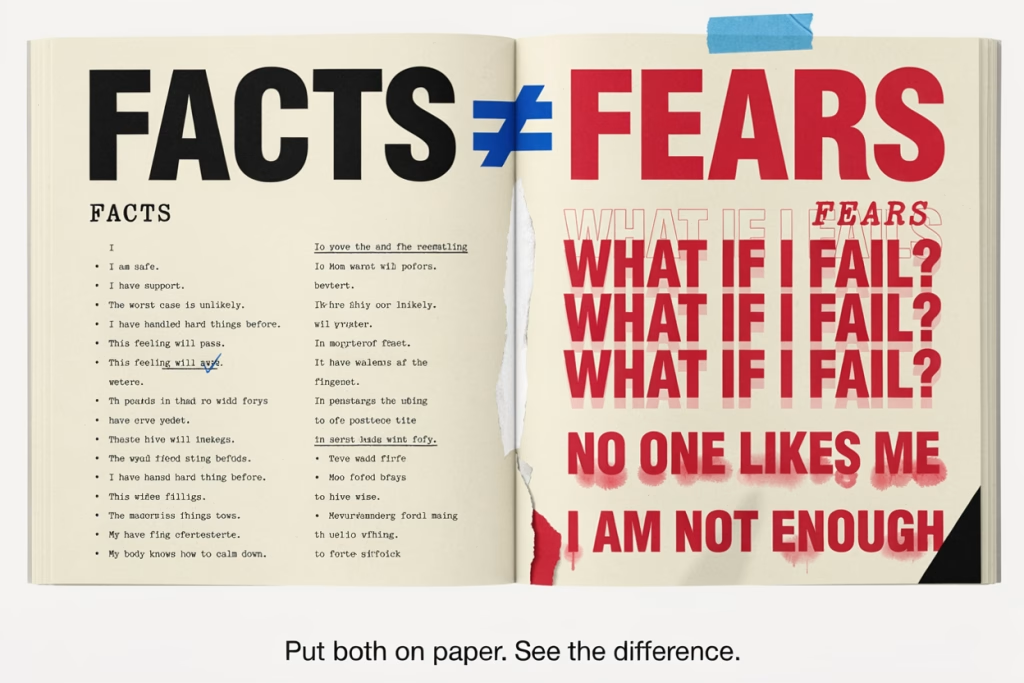
3. Facts Versus Fears
Divide the page into two sections.
Under Facts, write what you genuinely know.
Under Fears, write what you’re predicting, imagining or assuming.
This will not make uncertainty disappear, but it can help you see where anxiety has filled in the missing information.
4. The Worry Page
Give your worries one page and a limited amount of time.
Write down everything your mind is trying to solve. Then sort each worry into:
- something I can act on
- something I need help with
- something I cannot solve today
Close the notebook when you’re finished. The worries may return, but you no longer need to rely on your brain to remember every one of them.
5. A Supportive Letter to Yourself
Write to yourself as though you were responding to someone you genuinely cared about.
You don’t have to shower yourself with compliments or pretend the situation is fine. Aim for honest kindness:
This is difficult. It makes sense that I’m tired. I don’t have to work everything out tonight.
If open-ended writing feels intimidating, these self-discovery journal prompts can give you somewhere to begin.
What If Journaling Makes You Feel Worse?
Journaling is not automatically helpful just because it involves a notebook.
Writing can become unhelpful when it turns into:
- replaying the same painful event without gaining any distance
- repeatedly criticising yourself
- documenting every anxious thought as though it were true
- forcing yourself to revisit trauma before you feel ready
- using your journal instead of seeking support
- monitoring your mood so intensely that it increases your anxiety
If you notice yourself becoming more distressed, panicked or stuck, stop. Put the journal away and do something that brings you back into the present step outside, drink some water, move your body, call someone you trust or focus on what you can see and hear around you.
You can also change the way you write. Instead of describing the painful event in detail, try:
- What would help me feel safer right now?
- What do I need after writing this?
- What is true in this present moment?
- Who could support me with this?
- What is one kind thing I can do for myself next?
You are allowed to decide that journaling is not the right tool for you today.
Journaling Is Support, Not Treatment
A notebook can help you reflect, process and notice patterns. It cannot diagnose a mental health condition or provide the care of a qualified professional.
Please consider talking to a GP or mental health professional if difficult thoughts or feelings are persistent, worsening or interfering with everyday life.
If you are in immediate danger or believe you may harm yourself or someone else, call 000 in Australia or your local emergency number. You can also contact Lifeline on 13 11 14 for 24-hour crisis support.
I’ve gathered additional Australian and international services on the Mental Health Resources page.
Final Thoughts: Your Journal Doesn’t Have to Heal You
Your journal does not have to transform your life.
It can simply be the place where you stop pretending you’re fine for five minutes. The place where a shapeless feeling becomes a sentence. The place where you notice that something keeps hurting or that something has slowly begun to change.
Some entries will bring clarity. Others will be confused, repetitive or unfinished. That does not mean you are doing it wrong.
Start with what is true right now.
One sentence is enough.