Journaling to Organise Your Thoughts: Turning Mental Chaos into Clarity
Some days, your brain feels less like a brain and more like a group chat where everyone is talking at once.
You’re thinking about the email you forgot to answer, the appointment you need to book, something awkward you said three days ago, whether you should change jobs, what’s for dinner and the fact that you still haven’t put the washing away.
None of these thoughts is necessarily huge. There are just too many of them competing for the same small patch of mental space.
This is where journaling to organise your thoughts can genuinely help.
Not because writing magically fixes your life. It doesn’t. The email still needs an answer and the washing remains aggressively unfolded. But putting your thoughts somewhere visible can make them easier to understand, sort and act on.
You stop trying to remember, process and solve everything at the same time.
And sometimes, that is the difference between mental chaos and knowing what to do next.
Why Does Writing Down Your Thoughts Help?
Your brain is good at having thoughts. It is less good at storing 47 unrelated reminders while also making decisions and regulating your emotions.
Writing creates an external place to hold some of that information. Researchers call this cognitive offloading: using something outside your mind such as a notebook, calendar, list or phone to reduce the amount you need to keep actively available in your memory.
In other words, the page remembers things so your brain doesn’t have to keep yelling them at you.
Research has found that unfinished goals can continue to interrupt our attention. In one series of studies, forming a specific plan for an unfinished task reduced those intrusive thoughts and their effect on unrelated activities. The task had not been completed, but the brain no longer needed to keep rehearsing it because there was a plan for returning to it. You can read the study through the National Library of Medicine.
Expressive writing—the more emotional kind of journaling—has also been studied for its possible effect on working memory. One study found improvements in working-memory capacity following writing about stressful experiences, although journaling research as a whole is more nuanced than the internet sometimes makes it sound. It can be helpful, but it is not a guaranteed cure for stress, anxiety or anything else. Here is the published study abstract if you want to look beyond the usual “journaling changes your brain” headline.
The practical explanation is simpler:
- Writing gives a vague thought a definite shape.
- It helps you separate facts from fears and assumptions.
- It shows you which thoughts are tasks, which are feelings and which are simply mental noise.
- It creates a record you can return to instead of mentally starting again each time.
- It can turn “everything is too much” into “these are the four things bothering me.”
Four things may still be annoying. But four things can be looked at individually. “Everything” cannot.
What Journaling for Mental Clarity Actually Looks Like
Journaling to organise your thoughts does not require three handwritten pages every morning.
You can write:
- a chaotic list;
- half a sentence;
- a mind map;
- a page of questions;
- three bullet points in your phone;
- a detailed account of what is bothering you;
- one task you need to remember tomorrow.
The goal is not to produce a beautiful journal entry. The goal is to make your thoughts easier to see.
If you’re new to the whole thing, the beginner’s guide to journaling covers the basics without turning journaling into another elaborate routine you have to maintain.
The Difference Between a Brain Dump and an Actual Plan
A brain dump is useful, but it is only the first half of the process.
If you write down 36 tasks, five worries and a vague sense that your entire life is behind schedule, then close the notebook, you may feel temporarily lighter. You may also feel slightly horrified by the list you have created.
That doesn’t mean the brain dump failed. It means you have reached the sorting stage.
Think of it this way:
The brain dump empties the drawer. Organising decides what goes back in.
You do not need to organise every entry. Sometimes getting something out is enough. But when you want clarity or a next step, you need to do more than unload.
A Simple System for Organising Chaotic Thoughts
Start by writing down everything taking up space in your mind. Do not organise as you write. Mixing “book dentist” with “I think my friend is annoyed with me” is completely fine.
Once the page is full or your mind feels quieter read through it once.
Sort each item into one of these five categories.
1. Do
These are specific actions you can complete.
Examples:
- Reply to Mia’s email.
- Pay the electricity bill.
- Book a GP appointment.
- Put the clean washing away.
- Submit the form by Friday.
If something belongs in this category, give it a next action. “Sort out finances” is too broad. “Open the last three bank statements” is something you can actually begin.
2. Decide
These thoughts require a choice rather than a task.
Examples:
- Do I want to attend that event?
- Should I renew this subscription?
- Am I taking on too much work?
- Is this project still worth pursuing?
Write down the decision you are making, the options available and what information you still need. Do not force an immediate answer simply because you opened a notebook.
Sometimes the clearest result of journaling is: I am not ready to decide this yet.
That is still more useful than repeatedly thinking, “I really need to work out what I’m doing.”
3. Discuss
Some problems cannot be solved privately on paper because another person is involved.
Examples:
- A recurring issue with your partner.
- Confusion about a work expectation.
- A boundary that needs to be communicated.
- Something you need to ask rather than assume.
Journaling can help you prepare for the conversation. It cannot have the conversation for you.
Try writing:
- What happened?
- What am I assuming?
- What do I need to clarify?
- What would I like to say?
- What outcome am I hoping for?
This can help you enter the discussion with something more useful than three days of rehearsed arguments against a person who has no idea there is a problem.
4. Feel
Not every thought is a task in disguise.
Grief, anger, disappointment, loneliness and fear do not always need to become action points. Sometimes the honest entry is simply:
I am upset about this, and I cannot solve it tonight.
Naming a feeling can help you stop treating it as evidence that everything is wrong. You may be angry about one interaction, anxious about one uncertainty or exhausted after one difficult week.
That feeling matters. It just may not be the whole story.
If you want to understand what sits beneath the mental noise, these self-discovery journaling prompts can help you look for patterns without forcing a dramatic personal breakthrough.
5. Release
This category is for thoughts that require neither a task nor a twelve-part investigation.
Examples:
- An awkward moment nobody else remembers.
- A problem that belongs to someone else.
- A hypothetical disaster with no evidence behind it.
- A task you have decided not to do.
- An expectation you no longer agree with.
“Release” does not mean ordering yourself to stop caring. It means recognising that continuing to mentally circle the thought is not producing anything new.
You might write:
I have thought about this enough for today. There is no action available to me right now.
Then leave it on the page.
Five Journaling Methods for Organising Your Thoughts
Different kinds of mental clutter need different tools. A giant brain dump is not always the answer.
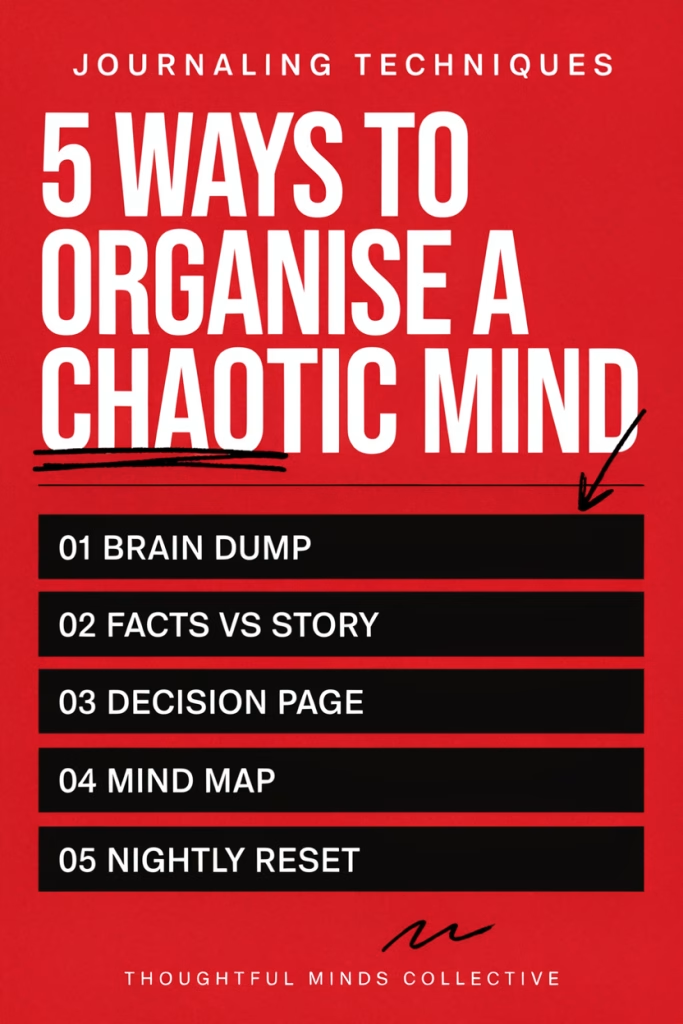
1. The Unfiltered Brain Dump
Use this when your mind feels crowded but you cannot identify why.
Set a timer for five or ten minutes and write down everything that appears. Tasks, worries, fragments, reminders and petty complaints all count.
Do not pause to prioritise. If you begin editing the list while creating it, your internal project manager will take over and the quieter thoughts may never make it onto the page.
When the timer ends, underline anything that needs action. Circle anything emotional. Put a question mark beside anything you do not yet understand.
That is enough structure to begin.
2. The Facts, Story, Next Step Page
Use this when one situation is dominating your thoughts.
Divide the page into three sections:
What I know
Write only the observable facts.
What I’m telling myself
Write the interpretation, prediction or fear you have attached to those facts.
What I can do next
Choose one realistic action, even if that action is waiting for more information.
For example:
What I know: They have not replied to my message for two days.
What I’m telling myself: They are upset with me and avoiding me.
What I can do next: Wait until tomorrow, then send one straightforward follow-up.
This method does not tell you that your concerns are irrational. It helps you see where the available evidence ends and your brain’s attempt to fill in the gaps begins.
3. The Decision Page
Use this when you keep reconsidering the same choice.
Write the decision at the top of the page, then answer:
- What are my actual options?
- What does each option cost me?
- What might each option give me?
- Which part of this decision is making me hesitate?
- Am I waiting for information or certainty?
- What would be “good enough” here?
- When will I make the decision?
The final question matters. Without a decision point, research can quietly become avoidance.
4. Stream-of-Consciousness Writing
Use this when your thoughts feel emotional, tangled or difficult to name.
Set a timer and write without trying to create a logical sequence. Follow the thought wherever it goes. You can contradict yourself, repeat the same sentence or stop halfway through.
This kind of writing often reveals the thought sitting underneath the obvious one.
“I’m stressed about work” might become “I’m worried I’ve taken on something I can’t sustain.”
“I’m annoyed at everyone” might become “I haven’t had an hour alone all week.”
If you want to try it properly, this guide to stream-of-consciousness journaling explains how to begin without editing yourself into silence.
5. The End-of-Day Mental Reset
Use this when your brain brings the entire day to bed with you.
Write brief answers to:
- What is still on my mind?
- Is there anything I need to do about it?
- What can wait until tomorrow?
- What am I carrying that is not mine to solve?
- What is the first thing I need to remember in the morning?
The NHS includes writing worries down, separating solvable problems from hypothetical concerns and creating a specific plan among its practical suggestions for managing persistent worry. Its worry-management guide is worth reading if nighttime overthinking is a regular problem.
The point of an evening reset is not to force yourself into perfect calm. It is to give tomorrow a holding place so you do not need to mentally rehearse it all night.
How to Prioritise When Everything Feels Important
A long list can make every item look equally urgent. It rarely is.
After your brain dump, ask these questions:
- What has a real deadline?
- What has a consequence if I ignore it?
- What is affecting other people?
- What has been taking up disproportionate mental space?
- What can be completed quickly?
- What can be delayed, delegated or dropped?
Then choose no more than three priorities for the day.
Not because every other task is meaningless, but because a priority list containing 14 items is just a to-do list wearing a more impressive name.
If you need a more practical way to turn journal entries into action, journaling for productivity explores how to plan without making your journal feel like an unpaid manager.
Useful Prompts for Organising Your Thoughts
You do not need to work through all of these. Pick the one that matches the problem in front of you.
When everything feels like too much
- What is taking up the most mental space right now?
- What am I trying not to forget?
- Which parts of this are facts, tasks, feelings or fears?
- What genuinely needs my attention today?
- What can wait without causing a disaster?
When you cannot make a decision
- What decision am I actually trying to make?
- What are my realistic options?
- What information am I missing?
- Am I looking for clarity or a guarantee?
- Which option fits the life I have—not the imaginary life where I have unlimited time and energy?
When you keep replaying a conversation
- What was actually said?
- What meaning did I attach to it?
- What do I wish I had said?
- Is there something I need to clarify?
- Would a conversation help, or am I trying to rewrite something that has already happened?
When your to-do list is out of control
- Which three tasks have real consequences?
- What is the smallest next action?
- What am I keeping on this list out of guilt?
- What can someone else do?
- What am I officially choosing not to complete?
When you feel mentally stuck
- What do I know?
- What am I assuming?
- What am I avoiding?
- What would make this 10% easier?
- What is one action I can take in the next 15 minutes?
When Journaling Makes You Feel More Overwhelmed
Journaling is not automatically helpful just because it involves a notebook.
Sometimes writing turns into rumination: repeating the same fear, argument or criticism without gaining information, perspective or a next step. You finish the entry feeling more wound up than when you started.
If that happens, try changing the structure.
- Set a ten-minute time limit.
- Finish with one sentence about what you need now.
- Separate facts from interpretations.
- Choose one next action.
- Write about something concrete and present.
- Stop writing if you feel yourself becoming more distressed.
You are also allowed to close the journal.
Writing is a tool, not a test of how emotionally self-aware you can be. If your thoughts feel relentless, frightening or difficult to manage, a journal does not need to carry the whole job. Speaking with a GP, psychologist or another qualified mental health professional may be more useful than trying to think your way through it alone.
You Do Not Need a Clear Mind to Start
Waiting until your thoughts are organised enough to journal rather defeats the purpose.
Begin with the mess.
Write the repeated thought, the unfinished task, the question you cannot answer and the thing you are tired of thinking about. Let the first version be contradictory and badly punctuated.
Then look at what is actually on the page.
Some of it will need action. Some will need a decision or conversation. Some of it will simply explain why you have felt so distracted. And some thoughts may look far less powerful once they are written in ordinary ink instead of being delivered by the dramatic narrator inside your head.
Journaling to organise your thoughts is not about manufacturing a permanently calm mind.
It is about creating enough room to tell the difference between what needs attention, what needs time and what does not need to come with you.
Frequently Asked Questions
How do I organise my thoughts through journaling?
Start with an unfiltered brain dump. Once everything is visible, separate the entries into tasks, decisions, feelings, conversations and thoughts you can release. Choose one to three realistic next actions rather than trying to solve the whole page.
What should I write when my mind feels cluttered?
Write what you are trying to remember, what you are worried about, what feels unfinished and what you are avoiding. Bullet points are enough. You do not need to explain every thought in detail.
Is it better to journal in the morning or at night?
Journal when the mental clutter is most noticeable. Morning journaling can help you choose priorities before the day begins. Evening journaling can help you record unfinished tasks and create a plan for tomorrow. There is no universal best time.
Can journaling help with overthinking?
Journaling may help you make overthinking more visible and structured, especially when you separate facts from assumptions or turn a solvable concern into a specific plan. Unstructured writing can sometimes become rumination, so use a timer or finish with a practical next step if you tend to get stuck in loops.
How long should I journal for mental clarity?
Five to ten minutes is enough for many of these exercises. Stop when you have identified what is occupying your mind and what, if anything, you want to do next. More writing is not automatically more useful.