Journaling for Self-Discovery: 10 Prompts to Understand Yourself Better
How well do you actually know yourself?
Not your job title, your usual coffee order or the version of you that knows how to make conversation. The quieter parts: what matters to you, what drains you, what you keep avoiding and what you might want if nobody else had an opinion.
These questions aren’t always easy to answer. Most of us spend a surprising amount of time reacting to work, relationships, responsibilities and whatever needs our attention next. It’s possible to move through years of your life without stopping to ask whether the person you’ve become still fits.
That’s where journaling for self-discovery can help.
Writing gives you somewhere to notice your own patterns without immediately having to fix them. You can follow a thought further than you normally would, question an old assumption or admit something you’re not ready to say aloud.
You don’t need to know exactly who you are before you begin. In fact, that’s rather the point.
The 10 self-discovery journal prompts below are designed to help you explore your values, experiences, fears and hopes without turning the exercise into another test you can somehow fail. Choose one that catches your attention, write honestly and see where it takes you.
What Does Self-Discovery Actually Mean?
Self-discovery can sound like a dramatic search for one hidden, authentic version of yourself. Real life is usually less cinematic.
It might mean realising that a goal you’ve been chasing no longer matters to you. Noticing that you always become smaller around a particular person. Understanding why a seemingly minor comment bothered you for three days. Remembering that you used to enjoy something before you became too busy or too self-conscious to do it.
You aren’t trying to uncover one final answer to the question “Who am I?” People change. Your priorities shift, new experiences reshape you and different parts of you appear in different situations.
Self-discovery is really the practice of paying attention: to what you value, how you respond, where you feel most like yourself and where your life feels out of step with what you need.
Why Journaling Can Help You Understand Yourself
Thoughts move quickly. We interrupt them, dismiss them, contradict them and move on before we have properly understood what they were trying to tell us. Writing slows that process down.
On the page, you can see your words rather than simply thinking them. You may notice the same frustration appearing in different situations, a value hidden underneath an argument or a belief you’ve repeated so often that it has started to feel like a fact.
Research into expressive writing suggests that some forms of reflective writing can support wellbeing, although the effects vary between people and depend on what and how they write. A 2025 systematic review of 51 studies found the most consistent results for wellbeing and positive emotions, while findings for stress, anxiety and physical health were more mixed.
In other words, journaling isn’t therapy in notebook form and it isn’t guaranteed to transform your life. What it can offer is a private place to organise an experience, put language around a feeling and ask better questions.
Before You Start: There Is No Correct Answer
A self-discovery prompt isn’t a personality test. You aren’t searching for the most impressive, emotionally intelligent or beautifully phrased response.
Try to write what is true before writing what sounds good.
That may mean your answer is uncertain. It may contradict something you wrote six months ago. It may be three scrappy bullet points rather than two pages of insight. All of that counts.
You can begin with:
- “I don’t know, but I keep thinking about…”
- “The answer I feel I should give is…”
- “If I’m completely honest…”
- “Part of me thinks… while another part thinks…”
If the blank page tends to shut your thoughts down, these low-pressure ways to start journaling can help you get moving.

10 Journaling Prompts for Self-Discovery
You don’t need to answer these prompts in order or finish all ten. Start with the question that creates the strongest reaction, whether that reaction is curiosity, discomfort or an immediate “absolutely not.” There is often something worth exploring there.
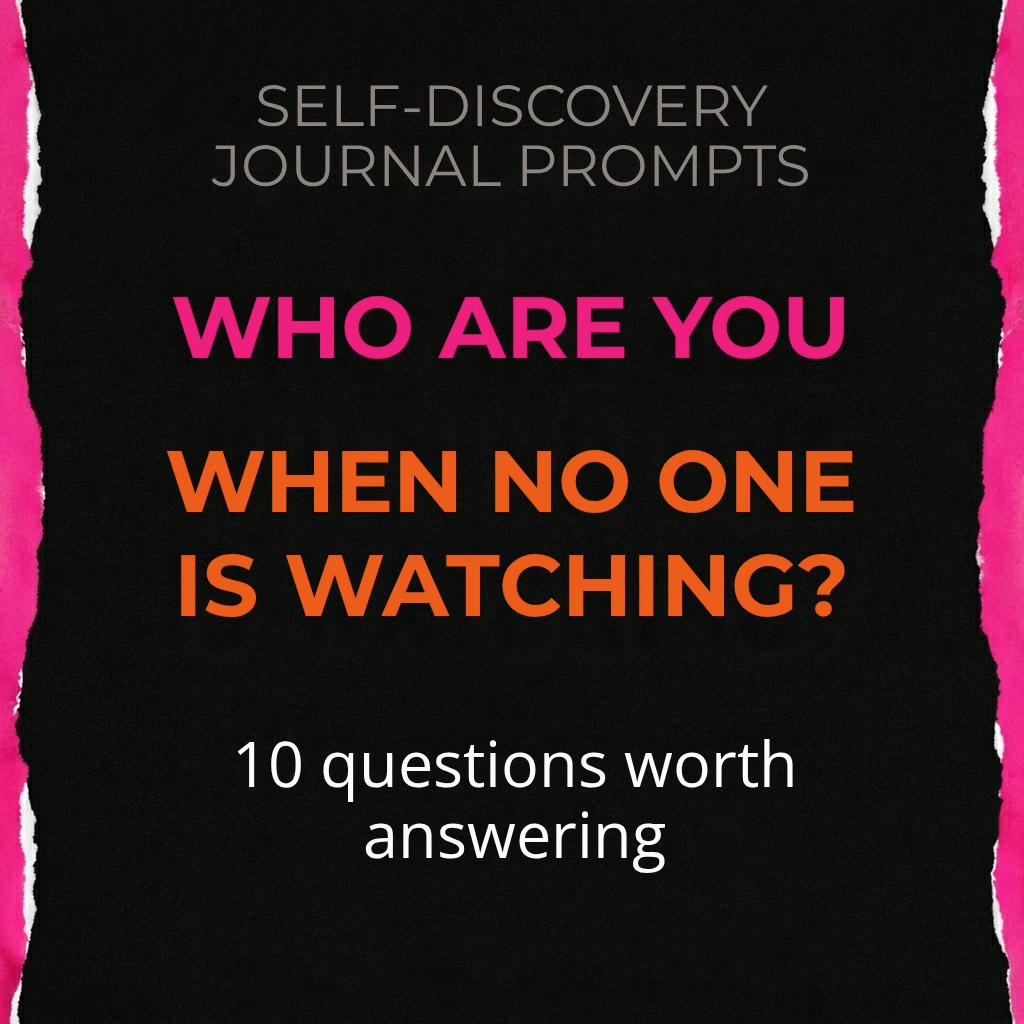
1. Who am I when no one is watching?
Think about the version of you that exists without an audience. What do you do when there is nobody to impress, reassure, entertain or accommodate? What interests do you return to? What makes you laugh? What do you wear, watch, read or think about when nobody else’s approval is involved?
This isn’t about deciding that your social self is fake. We all adjust to different people and situations. The question is whether the private parts of you have enough room in your life or whether you’ve become so practised at meeting expectations that you’re no longer sure what you prefer.
Go a little deeper: Where do you currently feel most free to be yourself? Where do you edit yourself the most?
2. What are the top five values that guide my life?
Values are the qualities and principles that matter to you: things such as honesty, stability, curiosity, independence, connection, creativity, fairness or adventure.
Choose five, then look at how they appear in your actual life. A value isn’t merely something you admire; it influences the choices you make and the way you want to live.
If you write “connection,” for example, when did you last make time for meaningful connection? If you choose “freedom,” what does freedom mean to you in practice more time, financial independence, fewer expectations or the ability to change direction?
You may also notice a gap between the values you genuinely hold and the ones you feel you should hold. That gap can tell you a great deal.
Go a little deeper: Which value is most visible in your life right now? Which one has been neglected?
3. What experiences have shaped me the most?
List the moments, relationships, decisions and changes that altered the way you see yourself or the world. They don’t all need to be major milestones. A teacher’s comment, a friendship ending, moving away from home or succeeding at something you expected to fail can leave a lasting mark.
Choose one experience and explore what changed afterwards. Did you become more cautious? More independent? Did you learn to keep people happy, expect disappointment or trust your ability to cope?
The goal isn’t to force every difficult experience into a lesson. Some things were simply painful or unfair. Instead, notice the meaning you attached to what happened and whether that meaning still serves you now.
Go a little deeper: What did this experience teach you about yourself? Is that lesson still true?
4. What brings me the deepest sense of fulfilment?
Think beyond what is productive, impressive or easy to photograph. When have you felt quietly satisfied with your life not because somebody praised you, but because the moment itself mattered?
Perhaps it happens when you make something, solve a problem, care for someone, learn, teach, organise, explore or spend time in a particular kind of environment. Look for the common thread underneath the activity.
It is also worth separating fulfilment from enjoyment. Scrolling on the sofa may feel enjoyable after a long day, but does it leave you restored? Training for something may be difficult, but does it leave you feeling capable and engaged?
You need both pleasure and meaning. This prompt simply helps you notice the difference.
Go a little deeper: What is one small way you could make more room for this in an ordinary week?
5. How do I handle challenges and what can I learn from my struggles?
When something goes wrong, what happens next? Do you become intensely practical, avoid it, assume the worst, ask for help, make jokes, overwork or shut down?
Try to observe your response without labelling it as good or bad. Many coping patterns began because they protected you or helped you get through something. The question is whether they are still useful in your current life.
Think about one recent challenge. What did you do well? What made the situation harder? What support did you need but not ask for? This creates a more accurate picture than either criticising yourself for everything or turning the experience into a forced story of growth.
Go a little deeper: What would handling a similar challenge with ten per cent more care look like next time?
6. What is something I’ve always wanted to do but been scared to try?
Name the thing before explaining why you can’t do it.
Maybe you want to travel alone, change careers, share your work, take a class, leave a relationship, perform, study or begin something you might not be immediately good at.
Then get specific about the fear. Are you afraid of failing or of being seen trying? Are you worried about money, judgement, uncertainty, disappointing someone or discovering that the dream feels different in real life?
Not every fear should be ignored. Some identify genuine risks that deserve planning. Others are discomfort dressed up as a final verdict. Writing can help you tell the difference.
Go a little deeper: What is the smallest, safest version of trying?
7. What would I say to my younger self?
Choose a particular age or moment rather than writing to a vague younger version of you. Picture what that person was worried about and what they couldn’t yet know.
What would you explain? What would you apologise for blaming them for? What did they survive, begin or understand before they had the words for it? What did they need an adult to notice?
You don’t have to write a sentimental letter or tell your younger self that everything works out. Perhaps the most honest message is that some things remain complicated, but they become more capable of meeting them.
Pay attention to any kindness you can offer your younger self but struggle to extend to who you are today.
Go a little deeper: What might your younger self be surprised or proud to know about you now?
8. What does my ideal day look like, from start to finish?
Don’t begin with a luxury holiday or a life with no obligations. Imagine an ordinary day that fits you well.
What time do you wake up? How rushed does the morning feel? Are you alone or with other people? What kind of work occupies you? How much structure, movement, quiet, conversation or creativity is there? What leaves you pleasantly tired rather than completely depleted?
Your ideal day won’t always be possible, and it doesn’t need to become a rigid routine. Treat it as information. If your imagined day contains three quiet hours and your real life contains three quiet minutes, that contrast deserves attention.
Go a little deeper: Which element of this day could you introduce now, without waiting for your whole life to change?
9. What limiting beliefs are holding me back?
A limiting belief is an assumption that narrows what you believe is possible: “I’m not creative,” “I always ruin things,” “It’s too late for me,” “I have to keep everyone happy” or “If I can’t do it properly, there is no point starting.”
Write down one belief you often repeat, then ask where it came from. Is it based on current evidence, an old experience, somebody else’s opinion or a rule you absorbed without choosing?
Avoid replacing it with an affirmation you don’t believe. Move towards something more balanced. “I always fail” might become “Some things haven’t worked, but that isn’t evidence that nothing will.” “I’m not confident” might become “Confidence usually comes after I practise, not before.”
The replacement doesn’t need to be relentlessly positive. It needs to be more accurate.
Go a little deeper: What might you do differently if you treated this belief as a thought rather than a fact?
10. Where do I see myself in five years and what steps could get me there?
Five-year questions can create unnecessary pressure, especially if you are still working out what you want. You don’t need a detailed prediction. Think in terms of direction.
How do you want your days to feel? What kind of relationships do you want around you? What would you like to have learned, changed, built, released or protected? What do you hope is no longer taking up so much of your energy?
Then bring the time frame closer. What would need to be true in one year? What could you explore in the next three months? What is one action you could take this week?
You are creating a possible path, not signing a contract with your future self. You are allowed to discover new information and change direction.
Go a little deeper: Which part of this imagined future feels like it came from you and which part sounds like somebody else’s definition of success?
What to Do After You Answer a Prompt
Insight is useful, but you don’t have to turn every journal entry into an improvement project.
Sometimes the next step is simply to notice. You might underline a sentence that surprised you, write a question in the margin or return to the entry a week later. If a practical action becomes obvious, keep it small: send one email, investigate one class, protect one free hour or have one honest conversation.
You can also look for repetition over time. Are the same needs, fears or frustrations appearing in different entries? Do you keep describing a version of life that has more rest, creativity or independence in it? Patterns often become easier to see when you stop expecting one writing session to produce a breakthrough.
If traditional long-form entries don’t suit the way your brain works, explore these different journaling styles for beginners. Lists, mind maps, voice notes and short bullet points can all support self-reflection.

How Often Should You Journal for Self-Discovery?
As often as it helps—not as often as the internet says a “real” journal keeper should.
You could choose one prompt every Sunday, write for ten minutes when your thoughts feel crowded or revisit the same question every few months to see what has changed. A regular practice can make patterns easier to spot, but consistency doesn’t have to mean daily.
If you’re new to journaling, the guide to starting a journal without overthinking it will help you find a realistic rhythm.
One useful boundary: if a prompt leaves you feeling overwhelmed, distressed or pulled deeply into a traumatic experience, you can stop. Put the journal away, do something grounding and seek support from a qualified mental health professional if you need it. Journaling can support reflection, but it doesn’t have to carry more than it safely can.
Self-Discovery Isn’t a Final Destination
There probably isn’t one perfectly defined “real you” waiting underneath everything else. You are shaped by what has happened to you, but also by what you choose next. You can hold conflicting needs. You can outgrow an old identity. You can change your mind.
Journaling for self-discovery gives you a place to keep meeting yourself as that happens.
You don’t need to complete all ten prompts tonight. Pick the question that stayed with you while you read this article. Write the first honest answer even if it is incomplete, untidy or not what you expected.
That is enough of a beginning.