Blank page panic?
Yep. We’ve all opened a journal, stared at the first empty page, and suddenly forgotten every thought we’ve ever had.
The weird thing about journaling is that getting started is often the hardest part. Not because you have nothing to say, but because you’re putting pressure on yourself to say the right thing.
The truth? There is no right thing.
Some days your journal will hold deep reflections. Other days it’ll be a grocery list, a brain dump, or a rant about something that annoyed you before lunch.
And that’s okay.
Overcoming the blank page isn’t about becoming a better writer. It’s about getting out of your own way long enough to begin.
If you’ve been staring at an empty notebook wondering where to start, these simple tips will help you stop overthinking and start writing.
Why Overcoming the Blank Page Even Matters
Not gonna lie journaling sounds chill until you’re face-to-face with an empty page and your mind goes poof. But pushing past that moment is where the magic begins.
And science backs it up:
- Expressive journaling can help reduce cortisol levels, AKA your stress hormone (Journal of Psychiatric Research)
- It’s legit good for your mood, according to the American Psychological Association
- Writing stuff down actually helps you remember more and think deeper (Advances in Physiology Education)
The benefits don’t come from writing perfectly.
They come from showing up consistently.
Research suggests that expressive writing can support emotional processing, reduce stress, and improve self-awareness over time. The goal isn’t to create something impressive. It’s simply to give your thoughts somewhere to go.
1. Use a Prompt (Because Staring into the Void Isn’t It)
Prompts are the ultimate hack for overcoming the blank page. They give you something to react to instead of pulling inspiration from the void.
- “One thing that made me smile today was…”
- “If my younger self could see me now…”
- “What’s something I’m holding onto that I need to let go of?”
- “What’s one feeling I need to name today?”
Still stuck? Our journaling prompt roundup has you covered.
2. Ditch the Perfectionism
This isn’t a school essay, babe. Journaling isn’t about writing something good it’s about being real. Say what you mean, mess up your spelling, write like you’re venting to your Notes app.
The moment you stop trying to be profound is the moment journaling actually starts working.
3. Time Yourself + Go
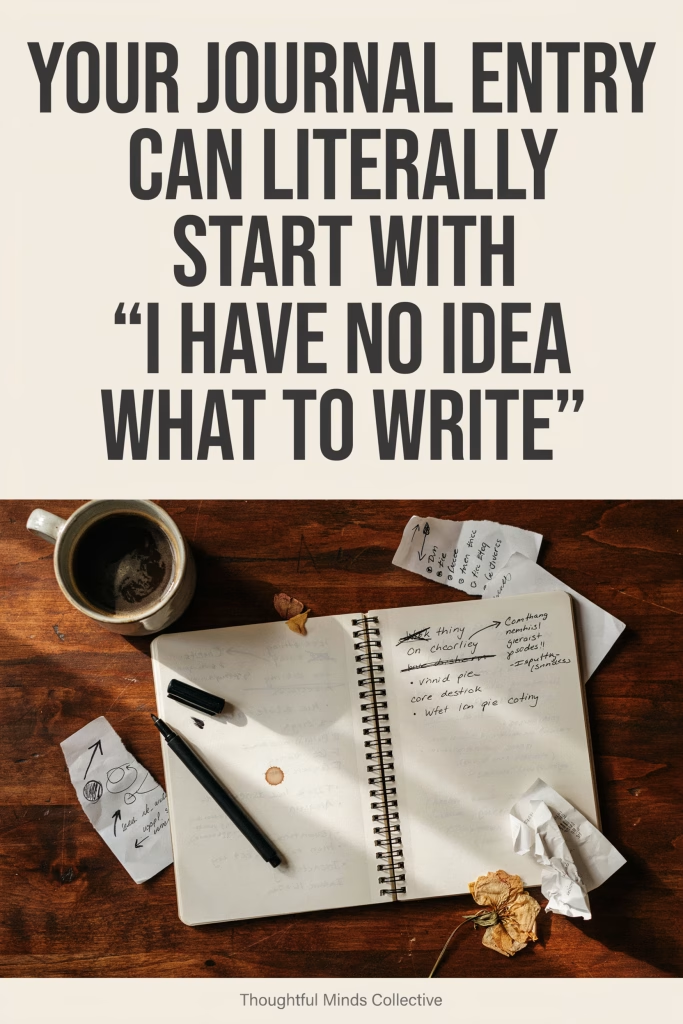
Try this: set a 5-minute timer and write nonstop. Even if it starts with “I don’t know what to write,” just keep going. You’ll be shocked at what your brain uncovers when it’s not being micromanaged.
This trick works wonders when you’re low-energy. Check out our lazy-day journaling hacks if you’re too tired to think.
4. Make a List, Not a Monologue
If paragraphs feel like too much, bullet points are your bestie:
- Songs stuck in my head today
- Little wins from this week
- Random thoughts I can’t shake
- My next 3 goals (realistic or chaotic)
- Emotions I felt today in one word each
Lists help you bypass your inner editor and just start.
5. Pair Journaling with a Vibe
You know how your skincare routine only stuck once you paired it with your fave playlist? Do the same with journaling.
- Journal while sipping your morning coffee
- Wind down with a quick brain dump before bed
- Keep a notebook in your car or bag
- Pair journaling with a mindfulness habit (we’re talking 2-minute breathing, not full-on Zen retreat)
Tiny rituals turn habits into something that actually sticks. Here’s how to build your own daily journaling routine.
6. Try a Different Medium
Not a “dear diary” kind of person? No problem. Try:
- Voice journaling (record thoughts as memos)
- Art journaling (doodle, collage, vibe out)
- Digital journaling (apps like Notion or Day One)
- Photo journaling (one pic a day with a caption)
Your journal should fit you, not the other way around.
7. Check in With Your Past Self
Go back and read your old entries once a month. It’s wild how much insight you’ll gain what’s changed, what patterns show up, what growth you might’ve missed. Reflecting is where the magic happens.
Wanna Make It Social?
If you’re down to share your journaling journey, here are a few low-key ways to connect:
- Follow hashtags like #journalingcommunity or #writeitout
- Join journaling challenges on TikTok or Pinterest
- DM or tag your fave journaling creators
- Share one quote, one win, or one page only if you want to
Final Vibe Check: The Blank Page Isn’t the Problem
Most people think they’re stuck because they don’t know what to write.
Usually, that’s not what’s happening.
You’re tired.
You’re overthinking.
You’re convinced your first sentence has to be meaningful.
So you stare at the page waiting for the perfect thought to arrive.
Meanwhile, the people who actually build a journaling habit are doing something much less glamorous.
They’re writing the messy sentence.
The random sentence.
The “I don’t even know why I’m writing this” sentence.
And somehow, that sentence always leads to another one.
The blank page isn’t asking you to be profound.
It’s asking you to begin.
So forget writing something beautiful.
Forget writing something wise.
Forget writing something worth posting online.
Write what’s true.
Write what’s annoying you.
Write what you’re avoiding.
Write what you had for breakfast if that’s all you’ve got today.
Because journaling isn’t about performing.
It’s about showing up.
And the moment a single word hits the page, it stops being blank.
That’s the win.
Need a Starting Point?
- What’s been taking up the most space in my mind lately?
- What do I wish someone would ask me today?
- What am I avoiding thinking about?
- What would make today feel 1% easier?
- What’s one thing I don’t want to forget about this season of my life?
Pick one.
Write the first answer that comes to mind. No editing. No pressure. No perfect words required.
Just start.