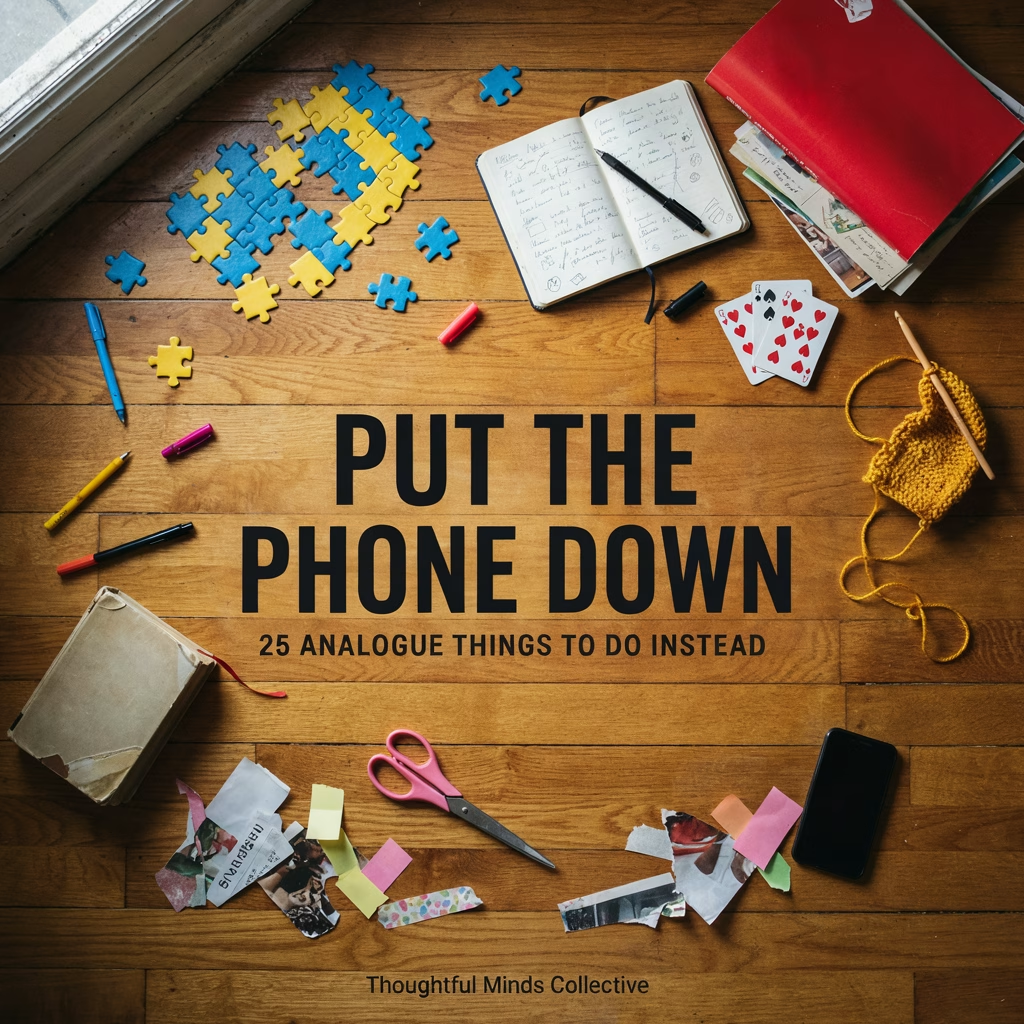
Analogue Living for Beginners: How to Spend Less Time Scrolling and More Time Living
You pick up your phone to check one thing.
Maybe it is the weather. Maybe someone messaged you. Maybe you genuinely need to look up what time the supermarket closes.
Then, somehow, 40 minutes disappear. You have watched a stranger reorganise her pantry, read half an argument between people you do not know and learned that a celebrity you barely recognise has launched a skincare brand.
You still do not know what time the supermarket closes.
When this keeps happening, the obvious solution seems to be more technology: another productivity app, another screen-time dashboard, another complicated digital detox plan.
But perhaps what we need is simpler.
Maybe we need more things in our lives that do not happen on a screen.
That is the basic idea behind analogue living. It is not about throwing your phone into the sea, moving to a cabin or pretending the internet was a terrible mistake. It is about deliberately putting physical, tactile and offline experiences back into a life that has become overwhelmingly digital.
You can use Google Maps, stream Netflix, work on a laptop and still live a little more analogue.
The point is not phone bad, paper good.
It is simply this: not everything has to happen through a screen.
What Is Analogue Living?
Analogue living means choosing to do some everyday things in the physical world instead of automatically reaching for a digital version.
It might look like:
- writing a shopping list on paper
- reading a paperback
- keeping a journal
- doing a crossword at the kitchen table
- playing cards with friends
- taking photographs and actually printing a few
- sketching, knitting, baking or building something with your hands
- carrying a book or puzzle for moments when you would normally scroll
In the United States, you will often see it called analog living, without the extra ue. You may also come across analog hobbies, offline hobbies, screen-free activities, tactile hobbies or slow hobbies. The wording varies, but the idea is much the same: make room for activities that have texture, edges, mess, movement and an ending.
That last part is more important than it sounds. A jigsaw puzzle ends. A cake comes out of the oven. A letter goes into an envelope. A book has a final page. A feed, by design, never finishes.
Why Is Analogue Living Having a Moment in 2026?
Analogue living is not new. People did not invent reading books and writing letters this year. What is new is the number of people deliberately choosing these things as an alternative to constant digital consumption.
The shift is visible across crafts, reading, letter writing and portable offline hobbies. The Associated Press has reported on younger people embracing hands-on “grandma hobbies”, including needlepoint, birdwatching, poetry and mahjong. The University of California, Riverside also noted that searches for “analog hobbies” on craft retailer Michaels’ website rose by 136 per cent over six months.
Pinterest’s own 2026 trend report points to one particularly charming corner of the movement: Pen Pals. Pinterest reported growth in searches for handwritten letters, pen-pal ideas, stamps and snail-mail gifts, driven largely by Gen Z and Millennials.
Even the “analogue bag” became a thing: a bag filled with a book, notebook, cards, craft supplies or another offline activity to reach for instead of a phone. The Guardian described its rise as a practical response to doomscrolling rather than a rejection of modern life.
The internet, with impeccable irony, is helping people discover ways to spend less time on the internet.

Analogue Does Not Mean Anti-Tech
Let us clear this up before anyone starts hiding the Wi-Fi router.
Analogue living does not require you to abandon useful technology. Your phone is a camera, map, bank, calendar, music player, communication device and emergency information source. Technology makes plenty of things quicker, safer and more accessible.
The problem is not that digital tools exist. It is that the phone can quietly become the default tool for every moment including the moments when we are bored, waiting, thinking, resting or trying to create.
Analogue living creates a few places where the phone is not automatically in charge.
You might use a notebook instead of opening Notes. Read three pages of a paperback rather than opening another app. Leave your phone at home while you walk around the block. Write a card instead of sending a quick reaction emoji. Take a notebook to a café and watch what is happening around you.
None of this needs to be permanent. You are allowed to write a paper to-do list and put the appointments into your digital calendar later. You can take film photographs and share them on Instagram. You can find a crochet tutorial on YouTube and then put the screen aside while you make the thing.
Technology and analogue life are not opposing teams. You are simply deciding which tool deserves your attention in a particular moment.
Why Are People Going Analogue?
There is no single reason. For most people, it is probably a mixture of the following.
Digital fatigue
We work, communicate, shop, bank, plan, socialise and entertain ourselves through screens. Even rest can start to feel suspiciously like more screen time just on a different app.
Analogue activities change the texture of the day. They ask your hands, eyes and attention to do something different.
Doomscrolling is not especially satisfying
Scrolling is easy to begin and difficult to finish. There is always one more post, video, outrage or tiny hit of novelty waiting beneath the last one.
That does not mean every minute online is wasted. It means passive consumption can swallow more leisure time than we intended to give it. An offline activity gives that time somewhere else to go.
Making something feels different from consuming something
A wonky sketch, badly knitted square or page of crossed-out thoughts is a physical thing that did not exist before you made it.
It does not have to be impressive. The appeal is often in participating rather than watching someone else participate beautifully.
Attention has fewer places to escape
A paper book does not send a notification halfway through a paragraph. A deck of cards does not open twelve new tabs. A notebook does not suddenly show you a video because an algorithm thinks you might enjoy it.
This does not make analogue activities magically distraction-proof. You can still stare out the window for twenty minutes. But they generally remove some of the competing inputs built into digital spaces.
Physical objects can hold memory and meaning
A digital photograph and a printed photograph contain the same image, but we often interact with them differently. One sits among thousands of files; the other might be tucked into a journal, placed on the fridge or passed around a table.
The same can be true of handwriting. In one study of university students and recent graduates, researchers found that recording calendar information on paper was associated with faster recall and greater brain activity during later retrieval than using a tablet or smartphone. The University of Tokyo’s explanation of the study suggests the spatial and tactile information of physical paper may play a role.
That does not mean handwriting is universally “better” or that typing does not count. It simply helps explain why a physical page can feel distinct and memorable.
Nostalgia is part of it and that is fine
Paperbacks, postcards, disposable cameras, CDs and old recipes can reconnect us with earlier versions of ourselves. Sometimes nostalgia is comforting. Sometimes it is just fun.
But you do not have to recreate 1997 to live more analogue. The goal is not to pretend modern technology never happened. It is to notice which older ways of doing things still add something worthwhile.
How to Start Living More Analogue
Please do not turn the following list into a 15-part self-improvement project.
Read it, notice what sounds appealing and choose one thing.
1. Keep a small notebook within reach
Put one where you usually scroll: beside the sofa, in your bag or on the kitchen bench. Use it for reminders, overheard phrases, rough plans or thoughts that would otherwise disappear.
It does not need a “purpose” before you begin.
2. Write a paper to-do list
Give yourself one small daily list instead of repeatedly unlocking your phone to check what needs doing. Try writing the three things that actually matter today, plus anything else as a bonus.
3. Read a physical book or magazine
Start with ten pages, not a solemn promise to read 52 books this year. Library books count. Old magazines count. Re-reading a comfort book absolutely counts.
4. Do a puzzle
Crosswords, sudoku, jigsaws and word searches give your brain something active to do without opening a feed. Keep one on the table so it is easier to begin.
5. Draw badly
You do not need talent, an online course or 48 alcohol markers. Use a pencil. Draw your coffee cup. Draw the dog. Draw an objectively terrible chair.
The point is to draw, not to become good enough to post it.
6. Cook from a printed recipe
Print the recipe or write it on a card so your phone is not sitting beside the flour, repeatedly locking itself at the worst possible moment.
7. Write a letter or postcard
It can be two paragraphs long. Tell someone what you have been doing, share a small memory or send the sort of message they might keep in a drawer.
8. Print a handful of photographs
Not all 14,000 of them. Pick ten. Put them in a cheap album, stick them into a notebook or write the story behind each one on the back.
9. Keep the scraps of a day or trip
Tickets, receipts, maps, packaging and little paper fragments can become a record of an experience. If perfect travel diaries never quite happen for you, this approach fits naturally with travel journaling for people who forget to travel journal.
10. Play cards or a board game
Choose something everyone already understands if a 40-minute rules explanation sounds like your personal nightmare.
11. Try a tactile hobby
Knit, mend, paint, garden, bake, carve, collage, build a model or learn a few chords. Borrow supplies before spending heavily. You are trying an activity, not opening a craft warehouse.
12. Make an analogue bag
Add a paperback, notebook, pen, small puzzle, sketchbook or portable craft. Take it to appointments, cafés, train rides or anywhere your phone normally fills the gaps.
13. Take a phone-free walk
Walk around the block without tracking it, photographing it or listening to anything. If leaving your phone behind is not practical, switch it to silent and keep it out of your hand.
14. Sit somewhere without filling the silence
Wait for your coffee. Sit in the backyard. Look out the train window. Let five unoccupied minutes remain unoccupied.
This one may feel oddly uncomfortable at first. That is interesting information, not failure.

Journaling as an Analogue Habit
Journaling is one of the easiest analogue habits to try because the barrier to entry is tiny.
Pen. Paper. That is the entire equipment list.
You can write about your day, make lists, record one good line, complain for three pages, paste in a receipt or write absolutely nothing profound. A journal is not an audition for the role of Most Interesting Person With a Notebook.
If you are completely new, this guide to journaling for beginners will help you start without turning the blank page into an exam. If long entries sound exhausting, one-line-a-day journaling is a much smaller place to begin.
There is no single correct method, either. Gratitude lists, brain dumps, art journaling and stream-of-consciousness writing all count. You can explore five beginner journaling styles and choose the one that feels least like homework.
The important part, from an analogue-living perspective, is not whether journaling transforms you. It is that for a few minutes you are making contact with your own thoughts without a notification barging through the door.
Paper Planning and Analogue Productivity
Analogue living is often bundled together with slow living, but using paper does not mean you must float serenely through your day while bread proves in the background.
Paper can be practical.
A brain dump gives loose tasks somewhere to land. A handwritten weekly plan makes the shape of the week visible. A habit tracker can show a pattern without sending reminders that begin to feel like passive-aggressive messages from your past self.
Try one page divided into:
- Must happen: genuinely time-sensitive tasks
- Would help: useful but not urgent tasks
- Can wait: everything your brain is pretending is an emergency
Or write the three things that matter today and ignore the urge to design an entire personal operating system.
If life feels administratively feral, the Life Admin Reset offers a realistic way to get the loose tasks out of your head. The Type B Productivity Guide is also built for people who want to get things done without adding guilt or pretending to be naturally organised.
Digital planning may still be best for shared calendars, repeating appointments and searchable information. Paper may be better for thinking, prioritising or seeing today at a glance. You are allowed to use both.
Want to try Paper Planning Without the Pressure?
The free Type B Productivity Reset Kit gives you seven printable pages for brain dumps, realistic priorities and getting things done without turning your life into a colour-coded productivity project.
No perfect routine. No new personality required.

The Type B Productivity Reset Kit
Free Download
Too much to do and no idea where to start? This free Type B Productivity Reset Kit helps you clear the mental clutter and focus on what actually matters
Do Not Fall Into the Analogue Aesthetic Trap
There is a slightly ridiculous thing that happens whenever people try to escape the internet: the internet immediately develops an aesthetic for it.
Suddenly analogue living appears to require a film camera, a record player, a fountain pen, linen clothing, a leather-bound journal and a sunlit desk in a house with no visible power cords.
Those things can be lovely. They are not entry requirements.
Analogue living can be a Bic pen, a $2 supermarket notebook, a dog-eared paperback and a crossword on the kitchen table. It can be a library card, an old deck of cards and photos printed at Officeworks. It can be scribbly, ordinary and completely unphotogenic.
Be especially wary of replacing one kind of consumption with another. You do not need to buy the entire identity before discovering whether you actually enjoy the hobby.
Use what you own. Borrow what you can. Buy the basic version if you need it.
The activity matters more than the aesthetic.
Try One Analogue Hour
If you are curious but do not know where to begin, try one analogue hour.
Put your phone somewhere mildly inconvenient not locked in a safe, just far enough away that reaching for it requires a decision.
Choose one physical activity:
- journal
- read
- draw
- cook
- walk
- do a puzzle
- plan your week
- organise printed photographs
- write a letter
- mend something
- play cards
Do not track the hour. Do not turn it into a challenge. Do not use it to prove that you are a disciplined person who has defeated technology.
Just notice whether the hour feels different.
Maybe you feel calmer. Maybe you feel restless. Maybe you become absorbed in something and forget to check the time. Maybe you discover that crosswords make you furious.
All useful information.
Analogue Living Is Not About Going Backwards
The internet is not going away, and most of us would not genuinely want it to. Analogue living is not an attempt to reverse time.
It is a way of deciding that technology does not need to mediate every spare minute.
You do not have to delete every app, replace every digital tool or become a person who develops film in the laundry. You only need to create one small alternative to scrolling something you can touch, make, finish, keep or share.
Choose one analogue thing.
Put a notebook beside the sofa. Borrow a paperback. Print five photographs. Take a deck of cards to a friend’s house. Walk around the block with your phone in your pocket.
Then see what happens when a little part of your life belongs only to you not to a screen, a feed or an algorithm.