


The Ultimate Beginner’s Guide to Journaling (and How to Actually Stick With It)
Journaling sounds great in theory.
A beautiful notebook. Deep thoughts. A calm morning routine. That main-character energy.
But when it’s actually you, a blank page and approximately 47 thoughts competing for attention, it can feel more like: What am I supposed to write?
Maybe you’ve tried journaling before but never stuck with it. Maybe you think your brain is too chaotic, your handwriting is too messy or your life isn’t interesting enough. Or perhaps you’ve seen so many elaborate journaling routines online that starting now feels weirdly intimidating.
This guide is for real people who want somewhere to think on paper without needing to be profound, productive or aesthetically pleasing.
You don’t need a perfect routine. You don’t need an expensive notebook. You don’t even need to write every day.
You just need somewhere to begin.
Journaling for Beginners: The Quick Version
If you want to start journaling today, do this:
- Find any notebook, piece of paper or notes app.
- Set a timer for five minutes.
- Begin with: “What’s taking up the most space in my head right now?”
- Write without correcting, organising or trying to sound wise.
- Stop when the timer ends or keep going if you want to.
That counts.
You have officially journaled.

Why I Wrote This Guide
When I first started journaling, so much of the advice felt either overly clinical or far too aesthetic for real life.
I didn’t know what I was supposed to write, how often I needed to do it or whether I was doing it “right.” What I actually needed was permission to be messy.
That’s why I created this guide and eventually this entire site for people who want a private place to make sense of their thoughts without turning journaling into another thing they can fail at.
Whether you’re processing something difficult, working towards a goal or simply trying to understand your own brain, your journal can meet you where you are.
What Is Journaling?
Journaling is the practice of recording your thoughts, feelings, experiences, observations or ideas.
That might mean writing three pages about something that happened. It could also mean:
- One sentence about your day
- A list of everything on your mind
- A few bullet points about how you feel
- A letter you never intend to send
- A page of drawings, scraps and half-finished thoughts
- Notes typed into your phone at 2 am
A journal doesn’t have to be a polished record of your life. It can simply be a place where your thoughts are allowed to exist outside your head.
Why Journaling Can Help
Journaling won’t solve every problem, and it isn’t a substitute for professional mental health support. But it can give you space to slow down, organise your thoughts and notice what you’re feeling.
Research into expressive writing suggests that writing about thoughts and emotions may offer modest mental health benefits for some people. A systematic review and meta-analysis found that journaling interventions produced a small but meaningful reduction in mental health symptoms, although results varied depending on the person and type of writing.
Harvard Health also notes that expressive writing may help some people process stressful experiences by organising their thoughts, making meaning from what happened and reducing endless mental cycling.
In everyday life, journaling can help you:
- Get circling thoughts out of your head
- Identify emotions that are difficult to name
- Notice recurring patterns
- Think through a decision
- Record memories you want to keep
- Explore ideas without needing anyone else’s approval
- Work out what you genuinely want
- Create a pause between feeling something and reacting to it
It may initially feel uncomfortable to write about something painful. You never have to push yourself into material that feels overwhelming. You can stop, change topics or reach out for support.
Your journal is a tool not a test of how deeply you can dig.
How to Start Journaling in Five Simple Steps
1. Choose the Easiest Format
Start with whatever creates the least resistance.
That could be:
- A cheap notebook
- Loose paper
- A document on your computer
- Your phone’s notes app
- A voice-to-text journal
- A guided printable page
You can buy the beautiful notebook later. For now, choose the format you’re most likely to open.
2. Make the First Session Small
Don’t begin by promising yourself three handwritten pages every morning for the rest of your life.
Try five minutes. One paragraph. Three bullet points. Even one honest sentence.
A small journaling practice you actually use is more valuable than an elaborate routine you keep avoiding.
3. Start With What Is Already in Your Head
You don’t need to find an important topic. Begin with the thought that keeps interrupting everything else.
Try:
- Right now, I’m thinking about…
- The thing taking up the most space in my head is…
- If I’m completely honest…
- Today felt…
- I don’t know what to write, but…
You can literally begin by complaining that you don’t know what to write. The page won’t mind.
4. Don’t Edit While You Write
Your journal doesn’t need correct spelling, elegant sentences or a satisfying conclusion.
Let yourself contradict yourself. Change direction halfway through. Write something dramatic and cross it out. Leave a sentence unfinished.
You’re thinking on paper, not submitting an assignment.
5. Stop Before It Becomes a Chore
You don’t have to fill the page.
If you’ve written enough, stop. Ending while journaling still feels manageable makes it easier to return next time.
What Type of Journaling Is Best for Beginners?
There is no single best journaling method. The easiest style is the one that solves your current problem without creating a new one.
Here are five beginner-friendly options.
1. Prompt-Based Journaling
A prompt gives your mind somewhere specific to begin. This is useful when an entirely blank page feels too open-ended.
Prompts can help you explore your mood, relationships, identity, goals or everyday life.
Try these easy journaling ideas and prompts for beginners.
2. One Line a Day
Write one sentence about your day. That’s it.
You might record something that happened, something you noticed or one thing you want to remember.
This method is ideal if you’re busy, tired or trying to rebuild a journaling habit without pressure.
Learn more about the One Line a Day journaling method.
3. Stream-of-Consciousness Journaling
Write whatever comes to mind without filtering, editing or organising it.
This is sometimes called a brain dump. It’s useful when you have too many thoughts and don’t know which one to start with.
If a blank page keeps stopping you, try this guide to overcoming the blank page.
4. Digital Journaling
If writing by hand feels slow or inconvenient, use your phone, tablet or computer.
A notes app, Google document or journaling app can work perfectly well. Digital journaling is especially useful when privacy, accessibility or convenience matters more than having a physical notebook.
The best format is the one you’ll actually use.
5. Art or Visual Journaling
A journal doesn’t have to be made entirely from words.
You can use:
- Doodles
- Collage
- Photographs
- Paint
- Stickers
- Ticket stubs
- Colour
- Scraps of conversations or song lyrics
Try this guide to art journaling for beginners if thinking visually feels more natural than writing paragraphs.
What Do You Write in a Journal?
Anything you want.
Your journal can hold what happened, how you feel, what you’re worried about, what you’re looking forward to or something completely ordinary that you don’t want to forget.
You could write about:
- What is taking up most of your headspace
- Something you wish you had said
- A decision you’re avoiding
- What gave you energy today
- What drained you
- A recent moment you want to remember
- An idea you don’t want to lose
- Something you’re learning about yourself
- What you need more or less of
- What you want tomorrow to feel like
Five Beginner Journal Prompts
- Right now, I’m feeling…
- The thought I keep returning to is…
- Something I need but haven’t admitted yet is…
- If I could speak completely honestly, I would say…
- One small thing I want to remember about today is…
If you’d like more direction, explore these 50 creative journaling prompts.
How Often Should a Beginner Journal?
As often as it helps.
You can journal:
- Daily for a few minutes
- Once a week for a longer reflection
- Whenever you feel overwhelmed
- When you need to make a decision
- While travelling or moving through a significant season
- Occasionally, with no fixed schedule at all
Daily journaling is not automatically better than weekly or as-needed journaling.
Consistency doesn’t have to mean doing something every day. It can simply mean returning to your journal when you need it.
Your journaling habit should feel like support—not another task monitoring your performance.
How Long Should You Journal For?
For a beginner, five to ten minutes is plenty.
You can also use a smaller limit:
- One sentence
- Three bullet points
- Half a page
- One prompt
- The length of one song
Stopping after two honest sentences doesn’t mean you failed. It means you wrote two honest sentences.
Some days you may want to continue for much longer. Other days, the shortest possible version will be enough.
Create a Journaling Routine That Fits Your Actual Life
Instead of building an entirely new ritual, attach journaling to something you already do.
For example:
- Write one line while drinking your morning coffee
- Brain-dump for five minutes before opening your email
- Keep your journal beside the sofa and write after dinner
- Add three bullet points to your phone before bed
- Reflect for ten minutes on Sunday afternoon
- Write in the car while waiting at school pickup
The routine doesn’t need to be impressive. It needs to be easy to remember.
You could also try Morning Pages, but you don’t have to commit to three full pages. Adapt the method until it works for your capacity and your life.
How to Stick With Journaling When You Usually Give Up
Make It Ridiculously Easy
Leave your journal somewhere visible. Keep a pen with it. Use the Notes app if getting the notebook feels like too many steps.
Reduce the gap between thinking I should journal and actually beginning.
Lower the Minimum
Your minimum could be one sentence.
You can always write more, but you never have to.
Stop Trying to Catch Up
If you miss a day, a week or six months, open to the next blank page.
You don’t owe your journal an explanation or a complete account of everything that happened while you were gone.
Use Prompts When You Need Them
Prompts aren’t cheating. They’re simply an entry point.
Keep a short list inside the front cover so you don’t have to search for inspiration every time.
Let the Method Change
You may need long emotional entries during one season and simple lists during another.
Changing how you journal doesn’t mean you lack consistency. It means the practice is adapting with you.
Don’t Turn It Into a Performance
You don’t need to photograph it, decorate it or make every spread Pinterest-worthy.
Your journal is allowed to be private, scrappy and visually unimpressive.
What If Journaling Feels Boring or Pointless?
Not every journaling session will produce a breakthrough.
Sometimes you’ll write about what you ate, complain about an annoying email or fill half a page without discovering anything at all.
That doesn’t make the practice pointless.
Journaling can work quietly. It creates a record, gives your thoughts somewhere to land and helps you notice patterns over time.
If it feels stale, change something:
- Switch from paragraphs to bullet points
- Answer a prompt
- Write a list instead of an entry
- Journal somewhere different
- Respond to a quote
- Write a letter you won’t send
- Describe one moment in detail
- Use colour, collage or drawings
- Take a break
You’re allowed to stop journaling when it isn’t helping. You can always come back differently.
Turn Your Journal Into a Safe Space, Not Another Productivity Tool
It’s easy to turn journaling into constant self-improvement: tracking, optimising, planning and finding new parts of yourself to fix.
Your journal can do those things, but it can also be somewhere you don’t have to improve at all.
Use it to:
- Feel something without immediately solving it
- Admit that you don’t know what to do
- Record a small moment that made you happy
- Be angry without making a decision
- Want something without justifying it
- Rest from trying to make every experience useful
A journal can hold uncertainty.
It can be the place where you’re allowed to exist before you’ve worked everything out.
If writing about distressing experiences makes you feel significantly worse or unsafe, pause and reach out for appropriate support. Journaling can complement professional care, but it doesn’t replace it.
Journaling Isn’t Only for Healing
You don’t need to be struggling to have something worth writing about.
Journaling can also help you imagine, plan and pay attention.
Try writing about:
- Your ideal ordinary day
- Something you want to learn
- A place you’d love to visit
- A project you can’t stop thinking about
- What “enough” would look like
- How you want your home to feel
- The person you’re becoming
- A tiny dream you haven’t told anyone about
Your journal doesn’t only have to document the life you’ve lived. It can help you explore the life you might want next.
If you enjoy this kind of reflection, try vision journaling.
Still Don’t Know What to Write?
Borrow a beginning:
- I don’t know what to write, but…
- The honest version is…
- Lately, I’ve noticed…
- Part of me wants…
- Part of me is worried that…
- The thing I keep avoiding is…
- Today would feel easier if…
- I wish someone would tell me…
You can also:
- Pick a prompt at random
- Copy a quote and respond to it
- Describe the room around you
- Write a letter you’ll never send
- Make a list of current thoughts
- Write about why you don’t feel like journaling
The first sentence only needs to open the door. It doesn’t need to know where the entry is going.
Try Journaling for the Length of One Song
If sitting in silence makes journaling feel overly serious, use music as a timer.
Choose one song and write until it ends.
You could create different playlists for:
- Quiet reflection
- Emotional release
- Brain-dumping
- Dreaming and planning
- Writing when you need a little attitude
The music isn’t a requirement. It’s simply one more way to make journaling feel like something you want to return to.
Journaling for Beginners: Frequently Asked Questions
All you need is somewhere to record your thoughts, such as a notebook, loose paper, notes app or digital document. You don’t need special supplies or a particular journaling method.
Start with whatever is already on your mind. You could describe how you feel, record something that happened, answer a prompt, make a list or begin with: “The thing taking up the most space in my head is…”
No. You can journal daily, weekly or only when you need it. A useful journaling habit is one that supports you, not one that makes you feel guilty.
Five to ten minutes is enough, but even one honest sentence counts. Start small and continue only if you want to.
Yes. Digital journaling is still journaling. Your phone can be more convenient, private and accessible than a physical notebook.
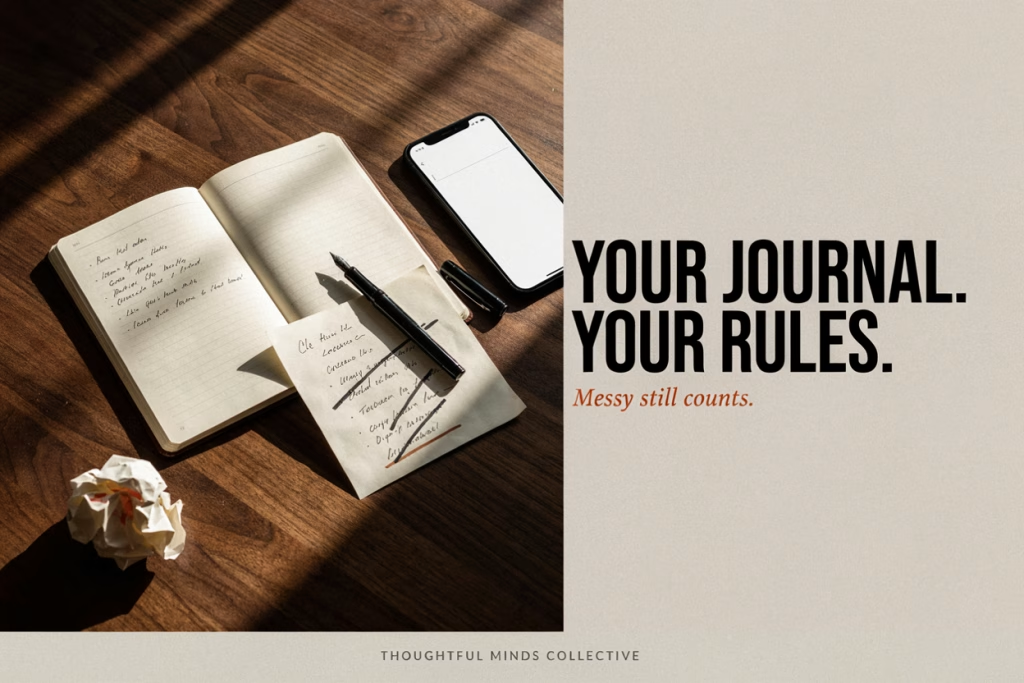
Your Journal, Your Rules
Forget the pressure to be profound.
Your journal can be messy, half-finished, nonlinear, loud, quiet, poetic, chaotic or incredibly ordinary.
You can journal every morning and then disappear for three months. You can write pages one day and a single word the next. You can change notebooks, switch methods and ignore every piece of advice in this guide that doesn’t work for you.
You are not doing it wrong.
You’re learning what journaling looks like in your life.
And that is the whole point.
Journaling for Beginners: Your Starter Checklist
- Choose the easiest format available
- Begin with five minutes or one sentence
- Write what is already taking up space in your head
- Try prompts, one-line entries or a brain dump
- Don’t edit while you write
- Journal as often as it genuinely helps
- Let your method change when your needs change
- Skip the pressure to make it beautiful
- Stop if writing feels overwhelming
- Return whenever you want without catching up
Ready to begin? Explore the free journaling resources or choose one prompt from this guide and write your first sentence now.
Its like you read my mind! You seem to know
a lot about this, like you wrote the book in it or something.
I think that you could do with a few pics to drive the message home
a bit, but other than that, this is wonderful blog. A fantastic read.
I’ll definitely be back.
It’s really a nice and helpful piece of info. I am happy that you shared this useful information with us.
Please keep us informed like this. Thanks for sharing.
Excellent post. I was checking constantly this blog and I am impressed!
Very helpful information specially the last part 🙂 I care for such
info much. I was looking for this particular information for a very long
time. Thank you and good luck.
Couldn’t agree more with everything you’ve said here. You nailed it”