Beyond Words: Art Journaling for Beginners (Even If You Can’t Draw)
Sometimes you don’t know what to write. You just know what colour it feels like.
That’s where art journaling comes in.
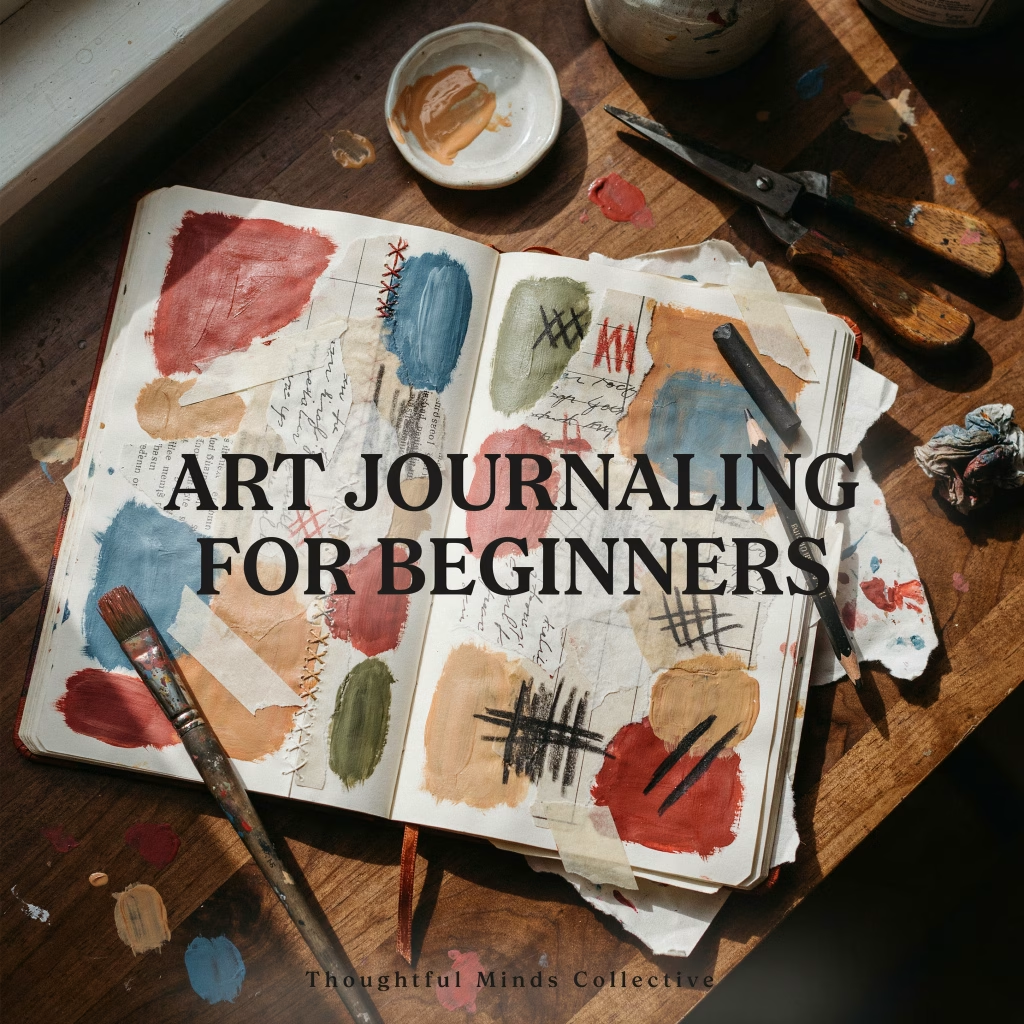
Art journaling for beginners doesn’t require drawing skills, expensive supplies or a notebook full of Pinterest-worthy pages. You can paint over words, glue in a train ticket, scribble across a page in black marker, make a collage from an old magazine or draw the wonkiest coffee cup known to humanity.
The point isn’t to make good art. The point is to make something.
If traditional journaling sometimes feels like sitting down and demanding that your brain produce three insightful paragraphs on command, art journaling gives you another language. Colour, texture, images, scraps, lines and absolute chaos are all allowed.
And some days, they say more than a page of words ever could.
What Is Art Journaling?
An art journal is simply a journal where visual expression is part of the process.
You might combine writing with paint, drawing, collage, photographs, stamps, fabric, stickers or whatever else you can reasonably persuade to stick to a page.
One entry might be three pages of writing with a tiny sketch in the corner. Another might contain no words whatsoever.
That flexibility is the whole appeal.
Unlike a sketchbook, which you might use primarily to practise or create artwork, an art journal can be about recording your life, exploring an idea, expressing a mood or simply making something because you feel like making something.
And unlike the beautifully coordinated journals you see online, yours doesn’t need a colour palette and a personal brand.
It can be ugly.
Actually, I recommend making at least one spectacularly ugly page early on. It gets the fear over with.
If you’re completely new to journaling in general, my Ultimate Guide to Journaling for Beginners covers the basics before you start attacking your notebook with a glue stick.
Why Art Journaling Can Feel So Good
There’s something different about using your hands.
You’re choosing colours, ripping paper, moving things around, drawing lines and making tiny decisions that don’t need to achieve anything particularly productive.
For a little while, you’re making instead of consuming.
That alone is one reason art journaling fits so naturally into analogue living. It’s a physical activity that doesn’t need Wi-Fi, notifications or an audience.
There’s also some interesting research around art-making and stress.
A small Drexel University study involving 39 adults measured cortisol before and after 45 minutes of art-making. Cortisol decreased significantly overall, with 75% of participants recording lower levels afterwards. Interestingly, previous art-making experience wasn’t associated with the change. Read the article from Drexel News At Any Skill Level, Making Art Reduces Stress Hormones.
That’s not evidence that doodling in your journal is a treatment for stress, and one small study shouldn’t be turned into a giant wellness claim.
But I do love one thing about it:
You apparently don’t have to be an artist to enjoy making art.
Which brings us to the biggest hurdle.
“But I’m Not Creative”
Excellent.
You can come in.
Art journaling is one of those hobbies that becomes considerably more enjoyable when you stop asking whether you’re doing it properly.
You don’t have to know how to draw a face. You don’t have to understand colour theory. You certainly don’t need to buy 47 matching brush pens because somebody on TikTok has arranged theirs beautifully in a Perspex drawer.
Start with whatever is already in your house.
A pen.
A highlighter.
An old magazine.
A receipt.
A glue stick you bought in 2019 that may or may not still function.
That’s enough.
If the blank page itself is what stops you, I’ve also got a guide to starting a journal when you don’t know what to write. The same principle applies here: you don’t need a brilliant idea before you begin.
What Do You Need to Start an Art Journal?
Very little.
For your actual journal, a sketchbook or mixed-media notebook is handy if you want to use wet paint because the thicker paper copes better. But if you’re mostly using pens, pencils, collage and stickers, use the notebook you’ve already got.
Then raid your drawers before you raid the craft shop.
A basic collection might include pens and pencils, a glue stick, scissors, old magazines or catalogues, highlighters, markers, stickers, washi tape, watercolours and random paper scraps.
You absolutely do not need all of them.
Half the fun is gradually discovering what you like.
Maybe you become a watercolour person. Maybe you’re happiest with black pen and torn newspaper. Maybe your journal eventually becomes so thick with photos, tickets and scraps that it refuses to close.
That’s your answer.

10 Easy Art Journaling Ideas for Beginners
Now for the fun bit.
Don’t treat these as assignments. Pick whichever one makes you want to reach for the notebook.
1. Make a Mood Page Without Writing the Mood
Instead of writing I’m angry or today was brilliant, try showing it.
Choose colours, shapes, lines and textures that match how the day feels.
Scratch angry lines into paint. Cover half the page in grey. Stick something ridiculous and sparkly over the top.
There doesn’t have to be a psychological meaning behind every choice.
Sometimes red means rage. Sometimes red was just the marker sitting closest to you.
Both are valid.
2. Destroy an Old Magazine
This is one of my favourites because you don’t need to create anything from scratch.
Grab a magazine and start looking for things that make you stop.
A face. A sentence. A colour. A weird advertisement. A photograph of a chair you’d never actually buy.
Cut or tear them out and arrange them on a page.
Don’t worry about what the collage means before you make it. Meaning can come afterwards.
Or not at all.
3. Draw Something Badly on Purpose
Seriously.
Draw your coffee cup in 30 seconds.
Draw your shoes without looking at the page.
Draw your dog and accidentally give it the proportions of a Victorian horse.
The goal is to break the connection between making art and making impressive art.
Once the page is already imperfect, you’re much freer to play with it.
4. Make a Page From Your Day
Keep the physical leftovers of an ordinary day.
A coffee receipt. A ticket. Packaging from something you ate. A little map. A business card. A note somebody gave you.
Stick them in and add a sentence or two around them.
Suddenly you’ve created a tiny physical record of a Tuesday that otherwise would have disappeared.
If you’re travelling, this works brilliantly alongside travel journaling, especially if you’re the kind of person who returns home with six museum tickets and absolutely no idea what to do with them.
5. Paint First, Write Later
Writing directly onto a pristine white page can feel strangely serious.
So ruin it first.
Swipe watercolour or acrylic paint across the paper. Make blocks of colour. Smudge something. Let it dry.
Then write over it.
The page already has a history before your first sentence arrives, which can make the whole thing feel much less intimidating.
6. Make a Visual Brain Dump
A brain dump doesn’t have to be a wall of handwriting.
Write words at odd angles. Circle things. Draw arrows between thoughts. Add symbols. Cross things out. Use different pens. Glue something over the thing you no longer want to look at.
There is no requirement for another human being to understand the finished page.
If your brain currently feels like 19 browser tabs fighting for RAM, this is basically the paper version.
7. Try Repetitive Patterns
Draw circles.
Then more circles.
Lines. Squares. Spirals. Leaves. Checkerboards. Tiny stars. Completely invented shapes.
You don’t need to turn it into an elaborate finished design. Repetition itself can be enjoyable when you want something for your hands to do without making a hundred decisions.
Put on music or a podcast and fill the page.
That’s it.
8. Create a Tiny Visual Time Capsule
Pick one moment you don’t want to forget.
Not the whole holiday. Not your entire year.
One moment.
Maybe it’s the light coming through your kitchen window at 7:13am. Your friend’s ridiculous drink order. The book you’re currently obsessed with. The song you played 19 times this week.
Add a photo, sketch, colour, lyric-free song title, receipt or a few words that capture it.
Small memories deserve pages too.
9. Make an “I Want More of This” Page
This is vision boarding without needing to manifest a villa in Tuscany by Thursday.
Instead of focusing on possessions or massive goals, collect images representing things you simply want more of.
More reading.
More swimming.
More dinners that last three hours.
More weekends without checking email.
More making things badly just because they’re fun.
If you like this approach, you can also experiment with different journaling techniques and mix the visual stuff with more traditional writing.
10. Make the Page You Would Never Post
This might be the most useful exercise on the list.
Make something with zero intention of showing anybody.
Use clashing colours. Bad handwriting. Private jokes. Ugly stickers. Cross things out. Glue something on crooked and refuse to fix it.
We spend so much time looking at other people’s beautifully edited creativity that it’s easy to start performing even when nobody is watching.
Your journal doesn’t need engagement.
It doesn’t need saves.
It doesn’t need to match your feed.
It just needs to belong to you.

What If Your Art Journal Looks Terrible?
Then congratulations.
You have made an art journal.
The internet has slightly distorted what journaling looks like because naturally the pages people photograph and upload are often the beautiful ones.
Nobody’s rushing to Pinterest with:
Here’s the page where my glue wrinkled everything, the paint bled through and I accidentally stuck the magazine woman directly over the sentence I wanted to keep.
But those pages exist too.
An art journal is allowed to be an object that’s been used rather than displayed.
Let paint bleed through.
Let the notebook get fat.
Let things hang out of the edges.
Let yourself hate a page and turn it over.
The next one can be completely different.
Art Journaling vs Art Therapy
This distinction matters.
Making art can be personally meaningful, relaxing or a useful way to express something that’s difficult to put into words. But art journaling at home is not the same thing as art therapy.
Art therapy is a mental-health profession involving trained professionals and a therapeutic relationship. The American Art Therapy Association specifically cautions against labelling ordinary creative activities or products as “art therapy.”
So your journal can absolutely be part of how you look after yourself.
It just doesn’t need to pretend to be treatment to be worthwhile.
What Should You Put on Your First Art Journal Page?
If you’re still staring at page one waiting for inspiration, steal this:
Write:
RIGHT NOW, LIFE FEELS LIKE…
Then stop writing.
Finish the sentence using colour, scraps, doodles, photographs, scribbles or whatever else you have nearby.
Don’t plan the finished page.
Give yourself ten minutes.
When the timer finishes, you’re done.
You’ve started an art journal.
You Don’t Need More Words. You Might Need a Glue Stick.
Traditional journaling isn’t the only way to record a life.
Some days you’ll want three pages of writing. Some days you’ll write one line. Some days you might cover a page in black paint, stick a cinema ticket over it and decide that’s quite enough introspection for one evening.
That’s the beauty of art journaling.
It gives you somewhere to put things that don’t arrive as neat sentences.
So don’t wait until you have the right notebook, better handwriting or enough artistic talent.
Grab what you’ve got.
Make something strange.
Make something ugly.
Make something that makes absolutely no sense to anyone else.
It doesn’t need to.
It’s yours.
If you’re still exploring what kind of journaling actually suits you, head to my Ultimate Guide to Journaling for Beginners or browse these simple journaling techniques and build your own version from there.