Morning Pages Journaling: What It Is, How to Do It & Why People Love It
You haven’t even got out of bed yet and your brain has already opened 17 tabs. Something you forgot to do yesterday. Something you need to do today. A conversation from three days ago that has apparently been scheduled for a 6:42am replay. And, for reasons nobody understands, the lyrics to a song you haven’t heard since 2007.
Morning Pages journaling gives all of that somewhere to go.
The idea is beautifully uncomplicated: wake up, grab a pen and write. No prompts. No pretty pages. No trying to sound profound. Just three pages of whatever is currently rattling around inside your head.
And yes, sometimes that’s going to be I have absolutely nothing to write. Keep going. That’s kind of the point.
What Are Morning Pages?
Morning Pages were popularised by author Julia Cameron through her bestselling book The Artist’s Way. Cameron describes Morning Pages as three pages of longhand, stream-of-consciousness writing, traditionally done first thing in the morning.
You write whatever comes into your head: plans, complaints, ideas, dreams, things you’re worried about, something ridiculous your partner did yesterday, the fact that you’re hungry or the fact that writing three pages suddenly feels like an extraordinarily large amount of writing.
It all counts.
Morning Pages are one of the foundational practices in The Artist’s Way, where Cameron uses them particularly as a tool for creative recovery. But you absolutely do not have to consider yourself creative, artistic or even particularly interested in writing to try them.
If you’ve never journaled before and the whole thing feels slightly mysterious, my guide to starting a journal when you don’t know what to write is a good place to begin.
What Do You Write in Morning Pages?

Anything.
That’s both the easiest and hardest part.
Morning Pages aren’t supposed to be a polished account of your life, and you’re not writing something you’ll publish later. You’re essentially letting your brain empty its pockets onto the page.
A morning might start something like:
I slept terribly. I really don’t want to make that phone call today. Need milk. Why did I agree to that thing on Saturday? Actually, maybe I’ll cancel it. I had the strangest dream…
And off you go.
One thought leads to another. Sometimes you’ll uncover something interesting. Sometimes you’ll work through a problem you’ve been circling for days. Sometimes you’ll write three pages about being tired, needing groceries and wondering why the dog was staring at the wall at 3am.
None of those sessions is more successful than another.
You wrote the pages. That’s enough.
If this kind of unfiltered writing appeals to you, you might also like stream-of-consciousness journaling, which uses a similar just-keep-writing approach without necessarily being tied to the morning or a specific number of pages.
Why Do People Write Morning Pages?
One of the biggest appeals is that you’re writing before you’ve consumed everybody else’s thoughts for the day. Before Instagram. Before email. Before the news. Before work messages. For a little while, it’s just your own thoughts on paper.
People use Morning Pages for all sorts of reasons. They might want to clear out mental clutter, explore ideas, notice recurring thoughts, work through decisions, develop a regular writing habit or simply make a little room for creativity before the day gets noisy.
There is also a substantial body of research into expressive writing more broadly. Psychologist James Pennebaker has spent decades studying what can happen when people write about thoughts, feelings and difficult experiences. In an American Psychological Association discussion about expressive writing, Pennebaker explains both the potential benefits and an important bit that often disappears from wellness articles: the results aren’t identical for everybody.
That’s worth being clear about. Research into expressive writing isn’t the same as research specifically testing Julia Cameron’s Morning Pages method, so I wouldn’t tell you that Morning Pages are scientifically proven to fix stress, anxiety, creativity or anything else.
They don’t need to be a miracle cure to be useful.
Sometimes getting what’s in your head onto paper is reason enough to pick up the pen.
If you’re particularly interested in using writing to explore how you’re feeling, I’ve gone into that in much more detail in my guide to journaling for mental health.
Morning Pages vs Journaling: What’s the Difference?
Morning Pages are a form of journaling, but they’re more structured than simply keeping a journal.
Traditional journaling can happen whenever you want. You might use prompts, write about a particular experience, keep lists, record memories or only open your journal when you feel like it.
Classic Morning Pages have three defining features: they’re written in the morning, they’re written by hand, and they’re three pages of stream-of-consciousness writing.
There’s also no requirement to reread them, analyse them or turn them into something useful. They’re the writing equivalent of opening a drawer and tipping everything onto the table.
We’ll sort it out later.
Or maybe we won’t.
How to Start Morning Pages Journaling
1. Put a Notebook Somewhere Obvious
Do this the night before. Leave your notebook on the bedside table, kitchen bench, next to the kettle or wherever you’re likely to stumble across it before your phone gets involved.
Removing even one tiny bit of friction makes starting easier. If you have to hunt through a cupboard for the beautiful notebook you bought six months ago, Instagram has probably already won.
2. Write Before You Start Consuming
Ideally, don’t begin your morning with email, social media or the news. You don’t need to build a sacred 5am routine involving lemon water, meditation and watching the sunrise.
Just try giving yourself a little space before the outside world gets first dibs on your attention.
Coffee is allowed.
Obviously.
3. Write by Hand
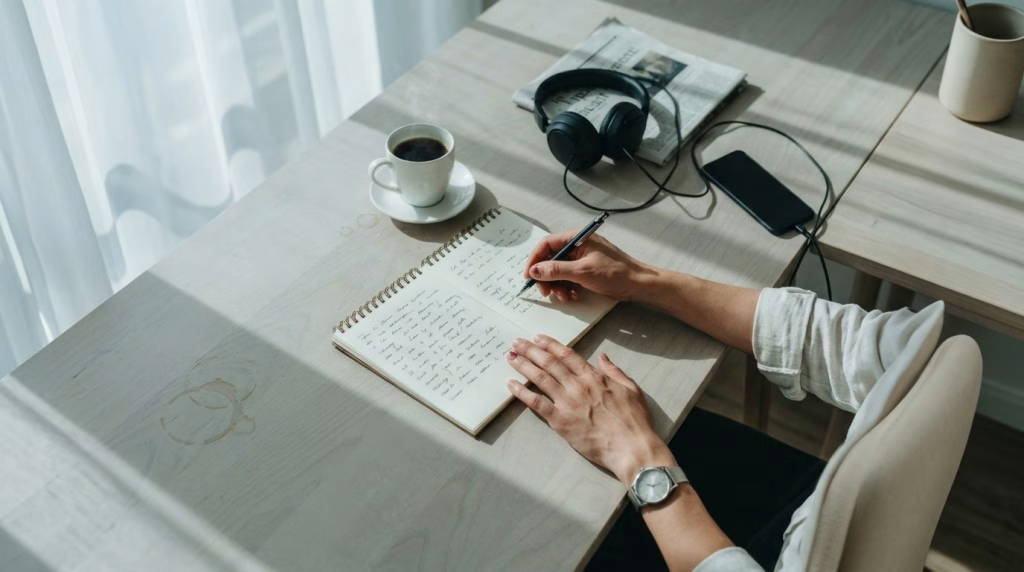
Cameron’s original Morning Pages practice is longhand, which is also part of what makes it such a lovely analogue habit.
There’s something satisfying about sitting down with an actual notebook and pen before spending the rest of the day surrounded by screens. If that’s a feeling you’re craving more of, my guide to analogue living for beginners explores plenty of other ways to bring physical, offline things back into everyday life.
And if handwriting three pages sounds appealing purely because you want a reason to step away from your phone, you might also enjoy these analogue hobbies to do instead of scrolling.
4. Keep the Pen Moving
This is where people get stuck because they think they need something worth saying.
You don’t.
Write I don’t know what to write. Then write why you don’t know what to write. Then complain about having to write at all. Eventually your brain usually finds somewhere else to go.
Don’t edit. Don’t correct your grammar. Don’t try to make your handwriting presentable.
Nobody is marking this.
5. Aim for Three Pages
Traditional Morning Pages means three handwritten pages, and that can sound enormous when you’re starting. Give it a go anyway. You may be surprised by how quickly three pages fill once you stop trying to make the words good.
But if the choice is between writing one page and abandoning Morning Pages completely because three feels impossible, I’d rather see you write the page.
You can build from there.
You’re creating a practice, not sitting an exam.
What If I Don’t Have 30 Minutes Every Morning?
Then don’t turn Morning Pages into another thing you’re failing at before breakfast.
Real mornings contain alarms that didn’t go off, children who can’t find shoes, early shifts, commutes, lunches that haven’t been packed and dogs making suspicious noises somewhere in the house. Sometimes half an hour of peaceful writing simply isn’t happening.
Try ten minutes. Try one page. Try Morning Pages three mornings a week. You can always experiment with the full traditional version when you’ve got more room for it.
There’s value in understanding Cameron’s original method without turning it into an all-or-nothing rule.
If consistency is the bit you usually struggle with, these journaling techniques for new writers might also help you find an approach that works better with your actual life.
Do Morning Pages Have to Be Done in the Morning?
If you’re following the original Morning Pages practice, yes — morning is part of the method.
But does that mean writing two pages at 2pm is suddenly useless?
Of course not.
That’s simply journaling rather than traditional Morning Pages, and that’s perfectly fine. The interesting question isn’t whether you’re doing journaling correctly. It’s whether you’re actually doing it and whether you’re getting something useful from the practice.
Do Morning Pages Have to Be Three Pages?
Again, three pages is the original method. Julia Cameron defines Morning Pages as three pages of longhand, stream-of-consciousness morning writing.
So if you want to experience the practice as intended, give three pages a proper try.
But don’t let the number become the reason your beautiful new notebook remains completely empty six months from now. Start where you can.
What If My Morning Pages Are Really Negative?
This can happen.
When you write without filtering yourself, complaints, worries, frustration and repetitive thoughts can appear pretty quickly. You don’t have to force every page into a positive ending or finish with three things you’re grateful for just to make the writing feel more acceptable.
But it is worth noticing how writing makes you feel.
Research into expressive writing doesn’t mean endlessly repeating the same painful story is automatically helpful. In the APA discussion mentioned earlier, Pennebaker talks about the importance of how people organise and make sense of experiences through writing rather than simply assuming that writing more is always better.
So if repeatedly writing about something leaves you feeling significantly worse, give yourself permission to stop, change what you’re writing about or seek appropriate support.
Your journal is a tool. It isn’t supposed to punish you.
You can also find Australian and international support options on my mental health resources page if journaling brings up something you feel you need more support with.
What If Someone Reads My Morning Pages?
Ah.
The question that has killed approximately eight billion honest journal entries.
Privacy matters when you’re trying to write without censoring yourself. Keep your notebook somewhere private, use an ordinary-looking notebook rather than one screaming MY DEEPEST PRIVATE THOUGHTS from the cover, and remember that you don’t have to keep Morning Pages forever.
If knowing you can tear them up later makes you more comfortable writing honestly, that’s an option too.
Morning Pages Aren’t Supposed to Be Pretty
This might be my favourite thing about them.
Morning Pages are almost the opposite of performative journaling. No elaborate spread required. No coordinated stationery. No carefully arranged desk. No handwriting that looks suspiciously like a font.
You need paper, a pen and whatever happens to be inside your head that morning.
That’s it.
Your pages can be messy. Your handwriting can deteriorate halfway down page two. You can cross things out, change subjects mid-sentence and write something that makes absolutely no sense when you look at it three months later.
Nobody needs to see it.
In a world where so much of what we create eventually becomes content, there’s something rather nice about making three pages that don’t need an audience.
Try Morning Pages Tomorrow
Tonight, put a notebook and pen somewhere you’ll see them. Tomorrow morning, try not to reach for your phone immediately. Open the notebook instead and write whatever shows up.
Don’t wait for insight. Don’t wait for creativity. Don’t wait until you’ve made the perfect coffee and found a peaceful sunlit corner of your house.
Just start.
Try the traditional three pages if you can. Try one page if that’s what gets you going. Try ten minutes if you’ve got somewhere to be.
Because the best journaling habit isn’t the most impressive one.
It’s the one that actually makes it onto the page.