How to Journal When You’re Mentally Exhausted (Without Making It Another Task)
You want to journal.
You know it might help. Your notebook is sitting right there. Maybe you’ve even carried it from the bed to the sofa and back again, as if proximity will somehow turn into motivation.
But your brain is done.
Not peacefully tired. Not “I had a productive day and now I deserve an early night” tired.
Mentally wrung out. Too many thoughts, no useful thoughts, and absolutely no desire to turn your feelings into three beautifully reflective pages.
I know this version of exhaustion. I still want the relief of getting things out of my head, but the thought of explaining any of it even to a blank page feels like work.
That’s the problem with a lot of journaling advice: it assumes you have enough energy to journal properly.
You need to choose a prompt. Reflect deeply. Identify the lesson. Set an intention. Perhaps finish with three things you’re grateful for.
No. Sometimes the only honest entry is:
Everything feels like too much and I don’t want to unpack it tonight.
That still counts.
Journaling when mentally exhausted should take something off your plate. It should not become another task you are failing to complete.
What Mental Exhaustion Can Feel Like
Mental exhaustion doesn’t always look dramatic.
Sometimes it looks like staring at a simple email for twenty minutes because you can’t work out how to answer it.
It can feel like:
- being unable to make one more decision
- forgetting what you were doing halfway through doing it
- becoming irritated by completely ordinary noises
- scrolling because choosing anything else requires thought
- feeling emotionally flat rather than obviously upset
- knowing you need something, but not knowing what
- wanting everyone to stop asking questions
- having a busy mind and a blank brain at the same time
Fatigue can affect concentration, short-term memory, judgement, motivation and mood. It can also have physical, psychological, medical or lifestyle-related causes, often working together. The Better Health Channel’s guide to fatigue explains the difference between ordinary tiredness and fatigue that may need further attention.
This matters because your inability to write a thoughtful journal entry is not necessarily a discipline problem.
Your brain may simply have very little processing power left.
Why Journaling Feels Harder When Your Brain Is Tired
Journaling sounds simple: open notebook, write thoughts.
But a traditional journal entry can require quite a lot from an exhausted brain. You have to decide where to begin, find words for what you’re feeling, organise those words into sentences and stay with the thought long enough to write it down.
Then there’s the invisible pressure to make the entry useful.
You might feel as though you should reach a conclusion, find the deeper meaning or come away knowing exactly what needs to change.
That’s a lot to ask when choosing what to eat already feels like advanced problem-solving.
The answer isn’t to force yourself through a “proper” entry. It’s to reduce the number of decisions involved.
On low-energy days, your journal does not need to be a place where you solve your life. It can just be somewhere you put down what you cannot keep carrying tonight.
First: Make the Journal Entry Smaller
Not shorter. Smaller.
A short entry can still feel demanding if you’re trying to make every sentence insightful. A small entry has a deliberately limited job.
It might help you:
- name the thing draining you
- capture one thought before it loops again
- decide what can wait until tomorrow
- say what you can’t be bothered explaining to another person
- notice whether you need rest, food, space, help or sleep
Choose one job. Not all five.
You are not writing the definitive account of your current mental state. You are leaving yourself a note.
The Bare-Minimum Journal Method
This is the method for nights when even picking a prompt feels excessive.
Write:
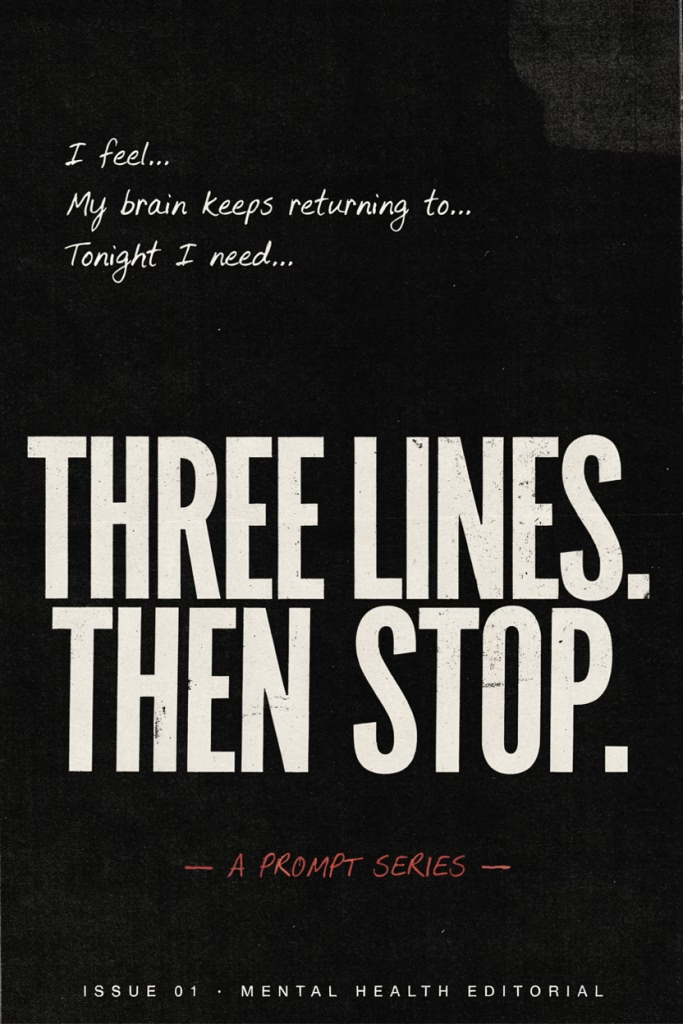
I feel:
One word is enough.
My brain keeps returning to:
Name the thought, person, task or problem.
Tonight I need:
Rest? Quiet? Food? Reassurance? To cancel something? To stop trying to fix it?
That’s it.
For example:
I feel: depleted.
My brain keeps returning to: everything I didn’t finish today.
Tonight I need: to stop treating the evening like extra work time.
Three lines. No breakthrough required.
If three lines still feel like too many, write one:
Today took more out of me than I had.
Close the notebook.
Try a Journal Menu Instead of an Open Page
“What should I write?” is another decision. Remove it.
Create a small low-energy menu on the inside cover of your journal or save it in your Notes app:
If I have 10 seconds
- One word for how I feel
- Energy: ___/10
- The main thing on my mind: ___
- Today was: too much / manageable / strange / numb / fine
If I have one minute
- What is draining me most?
- What can wait?
- What do I not want to talk about?
- What would make the next hour easier?
- What am I pretending isn’t bothering me?
If I have five minutes
- Write a messy list of everything taking up mental space.
- Describe what happened without analysing why.
- Write what you wish you could say uncensored.
- Divide a page into “mine to handle” and “not mine tonight.”
- Write until you notice the same thought repeating, then stop.
The point of the menu is not to work your way up through the levels. Ten seconds is not the beginner version of five minutes.
Pick the amount that matches the energy you actually have.
Six Low-Energy Ways to Journal
1. Write in fragments
Complete sentences are optional.
Try:
long day
too many messages
worried about money
annoyed by everything
need a shower
cannot make another decision
Fragments are often more honest because you don’t have enough space to edit them into something more acceptable.
2. Circle words instead of writing
Write a handful of words across a page:
angry — numb — overloaded — lonely — restless — disappointed — tired — relieved
Circle what fits.
Add one word underneath if you want to. Or don’t.
This works particularly well when you can feel something but cannot yet explain it. If emotional flatness is the bigger issue, these ideas for journaling when you feel numb may help without forcing a feeling that isn’t there.
3. Make an “everything is annoying me” list
Not every journal entry needs to be emotionally sophisticated.
Write down everything getting on your nerves:
- the laundry
- the unanswered message
- being asked what’s for dinner
- that noise
- my own indecision
- people needing things
- the appointment I forgot to book
Petty things are allowed. Often they are not the whole problem, but they reveal how little capacity you have left.
You do not have to turn the list into gratitude afterwards.
4. Record what happened, not how you feel
Sometimes “How do I feel?” is far too big a question.
Use facts instead:
Worked.
Forgot lunch.
Had an uncomfortable conversation.
Came home later than planned.
Couldn’t settle.
Now I’m exhausted.
You may understand the emotional part later. Tonight, recording the sequence is enough.
5. Use a voice note
If writing feels physically or mentally difficult, speak.
Open your phone and record a sixty-second voice note. You can ramble, whisper or say:
I don’t really know what’s wrong. I just know I’ve had enough for today.
You don’t have to transcribe it. You don’t even have to listen to it again.
The journal is the act of getting it out—not the notebook itself.
6. Write a stopping point
Instead of asking what you need to start, ask what you need to stop.
Finish one of these:
- I am not dealing with ___ tonight.
- Tomorrow can hold ___.
- I’ve thought about ___ enough for one day.
- Nothing useful will happen if I keep replaying ___.
- I’m allowed to leave ___ unfinished.
This gives the entry a boundary without pretending the problem has been solved.

Journal Prompts for When You’re Mentally Exhausted
These aren’t designed to produce profound answers. Choose the prompt that creates the least resistance.
When your thoughts won’t stop
- The thought taking up the most room is…
- What keeps replaying?
- What am I trying to mentally control?
- If I didn’t have to solve this tonight, what would change?
- What can I put down until tomorrow?
If your head feels crowded rather than blank, you might also like this practical guide to journaling to organise your thoughts.
When you’re emotionally flat
- I don’t know what I feel, but I notice…
- Today felt…
- The last thing I remember caring about was…
- What feels far away from me right now?
- What do I wish someone would notice without me explaining it?
When everything feels irritating
- I have no patience left for…
- The smallest thing that pushed me over the edge was…
- What has been asked of me today?
- What do I need people to stop asking me for?
- What boundary would protect the little energy I have left?
When you feel behind
- What am I mentally carrying as unfinished?
- Which task feels heavier than it really is?
- What genuinely needs attention tomorrow?
- What am I only doing because I think I should?
- If today were allowed to be enough, where would I stop?
When you don’t want a prompt at all
Start with:
The uncensored version is…
Then write whatever comes next.
No structure, no polishing and no trying to sound reasonable. This is close to stream-of-consciousness journaling, only you can stop after one sentence if that is all you have.
What If Journaling Makes You Feel Worse?
It can.
Writing about difficult experiences is not guaranteed to make you feel immediately calmer. Research into expressive writing has found potential psychological benefits, but the results are not universal, and writing about distressing experiences can temporarily increase negative feelings. A systematic review of journaling interventions found encouraging results overall, but also considerable variation between studies. The American Psychological Association’s discussion of expressive writing offers a useful, more measured look at what writing may—and may not—do.
So if opening the page sends you further into a spiral, stop.
You are not failing at journaling. It may be the wrong tool for that moment.
Try a factual list instead of emotional exploration. Write about what you can see in the room. Record what needs doing tomorrow. Or skip the journal completely and do something that asks less of you.
Journaling is an option, not an obligation.
You Don’t Have to Keep the Habit Alive
This is where journaling advice can get sneaky.
It tells you to lower the bar, but the real goal is still maintaining the streak.
Write one word so you can say you journaled. Keep showing up. Don’t break the habit.
But if you are mentally exhausted, protecting a journaling streak may be completely irrelevant.
You are allowed to miss days. You are allowed to leave your notebook untouched for a week. You are allowed to return without explaining your absence to the page.
Your journal does not feel rejected.
There’s no moral difference between someone who journals every morning and someone who writes only when their brain is unbearably loud. A journaling practice should fit your life. Your life should not have to perform for your journaling practice.
When Exhaustion Needs More Than a Journal
A journal can help you notice patterns, unload thoughts or find words for something that has been sitting heavily.
It cannot diagnose the cause of ongoing exhaustion, replace sleep, remove an unreasonable workload or give you support that you are not receiving elsewhere.
If the exhaustion is persistent, getting worse or making it difficult to manage ordinary life, it is worth talking to a GP or mental health professional. Fatigue can have many causes, including stress and burnout, sleep problems, depression, anxiety, medication effects and physical health conditions. Mental Health Support Resources Here.
You don’t need to wait until things are catastrophic before mentioning it.
You can also use your journal to prepare for that conversation:
- When did the exhaustion begin?
- Is it constant or does it come and go?
- How is your sleep?
- What daily activities have become harder?
- Have you noticed changes in mood, appetite, concentration or motivation?
- What have you tried so far?
That is journaling being useful without pretending it is the entire solution.
A Two-Minute Journal Page for Exhausted Days
If you want something you can return to without thinking, use this:
My energy is: ___ / 10
The loudest thing in my head is:
What has taken the most out of me:
What does not need to be solved tonight:
The kindest practical thing I can do next:
“Go to bed” is a valid answer.
So is “eat something,” “put my phone down,” “cancel tomorrow’s plan” or “ask someone else to handle it.”
It doesn’t have to sound beautiful. It only has to be true.
Your Exhausted Journal Entry Still Counts
You do not need to be insightful tonight.
You don’t need to find the lesson, reframe the day or end on an uplifting note. You don’t need to turn your exhaustion into evidence of personal growth.
Write the one thing you need out of your head.
Write a list with no punctuation.
Write, “I cannot explain this tonight.”
Or don’t write at all.
The journal will still be there when your brain has more to give.